
GEEKOM A6 Aurora Review: Ryzen 7 6800H Mini PC Under $650 [2026]
By Mini PC Lab Team · February 10, 2026 · Updated February 15, 2026
This article contains affiliate links. If you purchase through our links, we may earn a commission at no extra cost to you. We only recommend products we’ve thoroughly researched.
GEEKOM A6 Aurora Review: Ryzen 7 6800H Mini PC Under $650 [2026]
→ Check Current Price on Amazon
The GEEKOM A6 Aurora is the budget option in this product batch. The Ryzen 7 6800H is two generations old (Zen 3+ vs Zen 4/5), but at $649 with USB4 and WiFi 6E, it still offers solid value for users who don’t need cutting-edge AI features.
With an aluminium chassis, upgradeable DDR5, and GEEKOM’s 3-year warranty, the A6 Aurora is the pick for budget buyers who want a reliable daily driver without paying for AI capabilities they won’t use.
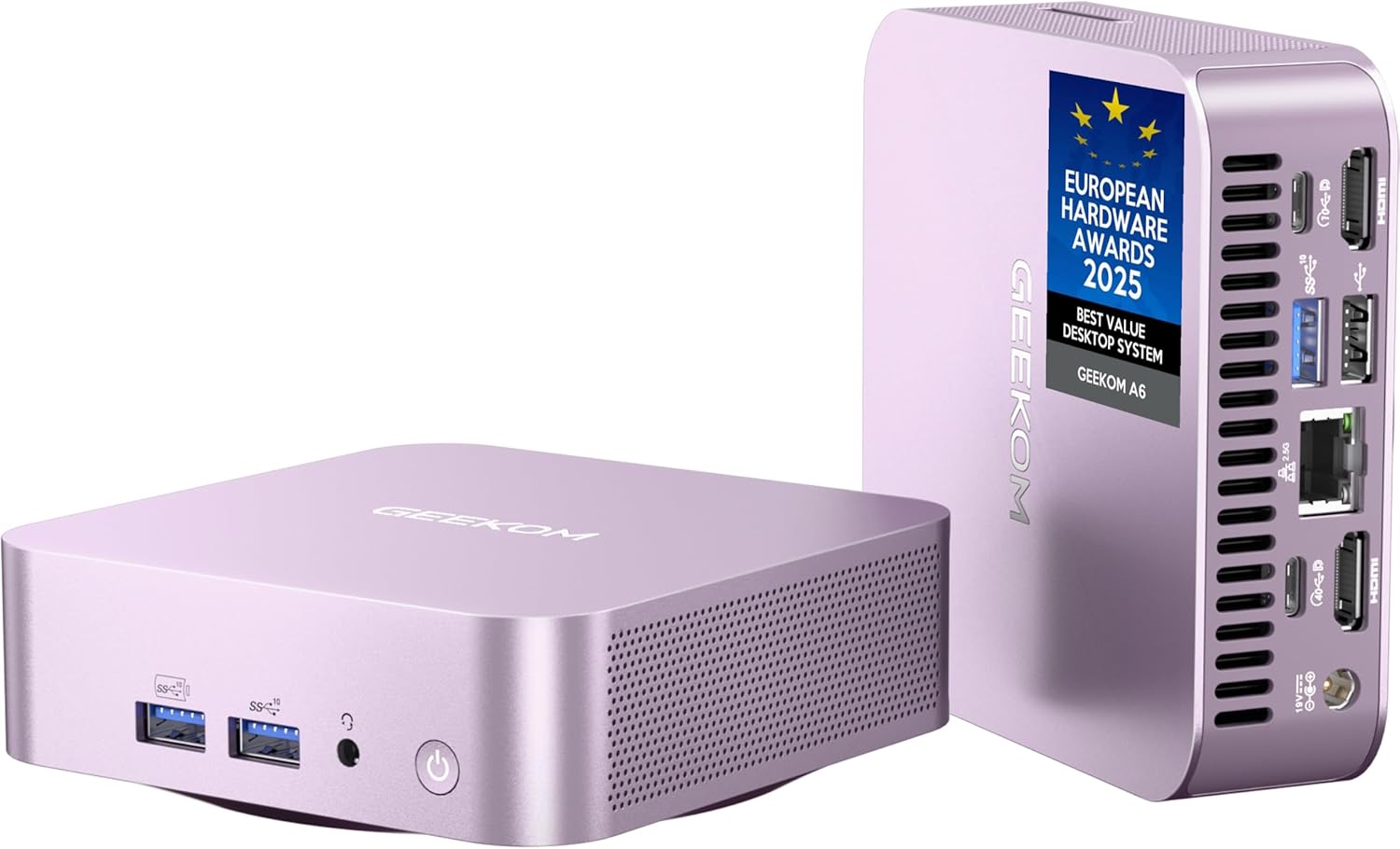
GEEKOM A6 Aurora — Specs at a Glance
| Spec | Detail |
|---|---|
| CPU | AMD Ryzen 7 6800H (8C/16T, up to 4.7 GHz, Zen 3+) |
| GPU | AMD Radeon 680M (RDNA 2, 12 CUs, 768 shaders) |
| RAM | 16GB DDR5 SO-DIMM (upgradeable to 64GB) |
| Storage | 1TB PCIe 4.0 NVMe SSD |
| Networking | 2.5GbE + WiFi 6E + Bluetooth 5.2 |
| Display | 8K UHD via USB4, HDMI |
| AI TOPS | 0 (no dedicated NPU) |
| USB | USB4 (40Gbps), USB-A 3.2 |
| Special Features | SD card slot, compact aluminium design |
| OS | Windows 11 Pro |
| Warranty | 3-year limited |
| Price | ~$649 |
| Rating | New listing (reference A7 MAX: 550 reviews, 4.6★) |
Design and Build Quality
The A6 Aurora follows GEEKOM’s established design language — compact aluminium chassis with a premium feel. Build quality is solid, and the chassis is small enough to mount behind a monitor using the included VESA bracket.
The front panel includes a power button and SD card slot — useful for content creators importing photos and videos. Port selection is adequate for the price: USB4, multiple USB-A 3.2, 2.5GbE, HDMI, and 3.5mm audio.
Build quality notes: The aluminium chassis feels premium and dissipates heat effectively. Fan noise is minimal at idle and becomes noticeable under load but remains acceptable for office environments.
CPU and Performance
The Ryzen 7 6800H is AMD’s Zen 3+ flagship — 8 cores and 16 threads at up to 4.7 GHz boost. While two generations old, the 6800H still delivers solid performance for general computing, office work, and light creative tasks.
For general workloads:
- Office productivity: Handles multitasking with ease
- Web browsing: Smooth even with dozens of tabs
- Light creative work: Handles 1080p video editing adequately
For AI workloads: The 6800H lacks a dedicated NPU. It relies on CPU/GPU compute for AI workloads. For Ollama LLM inference:
- 7B models (Q4): ~20-35 tokens/sec
- 13B models (Q4): ~8-15 tokens/sec
- 34B models (Q4): Limited by 16GB RAM
The Radeon 680M handles GPU-accelerated inference adequately, but without NPU acceleration, AI workloads are slower than on HX370/HX470 systems.
GPU and Graphics / AI Performance
The Radeon 680M with 12 RDNA 2 compute units (768 shaders) is AMD’s previous-gen iGPU — still capable for 1080p gaming at medium settings and light creative work.
For gaming:
- 1080p medium: Handles Cyberpunk 2077, Elden Ring at 30-40 fps
- Esports titles: Valorant, CS2, League of Legends run at 60+ fps
- Indie games: Most run smoothly at 1080p high
For creative workloads:
- Video editing: Handles 1080p editing well, 4K is possible but slower
- Photo editing: Lightroom and Photoshop run smoothly
For AI workloads:
- LLM inference: See tokens/sec above — the 680M handles GPU-accelerated inference adequately for 7B models
- Stable Diffusion: Generates 512x512 images in 15-25 seconds
Memory and Storage
The A6 Aurora uses DDR5 SO-DIMM — upgradeable to 64GB (2x 32GB sticks). The included 16GB is the bare minimum for 2026. For general use and 7B LLMs, it’s adequate. For 13B+ models or heavy multitasking, plan to upgrade to 32GB (~$80-100 for extra 16GB).
Why upgradeable RAM matters:
- General use: 16GB is adequate
- 7B LLMs: 16GB is comfortable
- 13B LLMs: 32GB recommended
- Video editing: 32GB+ recommended
Storage: Single M.2 slot supporting up to 4TB PCIe 4.0 NVMe. The included 1TB SSD is adequate for most users. For content creators, consider adding a second drive for project files.
Networking and Connectivity
| Port | Quantity |
|---|---|
| USB4 (40Gbps) | 1 |
| USB-A 3.2 Gen 2 | Multiple |
| HDMI 2.1 | 1 |
| 2.5GbE | 1 |
| SD card reader | 1 |
| 3.5mm audio | 1 |
Single 2.5GbE is standard for this price point. WiFi 6E is current-gen (one step behind WiFi 7). Bluetooth 5.2 is adequate. The SD card reader is a genuine differentiator for content creators — useful for importing photos and videos without a dongle.
USB4 at this price point is rare. The 40Gbps connection enables fast external storage and eGPU connections (with 20-30% performance loss vs direct PCIe).
Power Consumption and Running Costs
| Metric | Value | Source |
|---|---|---|
| Idle (W) | ~8W | Community estimate (Ryzen 7 6800H platform) |
| Load (W) | ~45W | Community estimate (Ryzen 7 6800H platform) |
| Annual Cost (24/7 idle) | ~$8.41/year | At $0.12/kWh |
Running 24/7 at idle, the A6 Aurora costs about $8.41 per year in electricity — about $0.70 per month. Under sustained load, power reaches ~45W, which is efficient for an 8-core system. The Zen 3+ architecture is power-efficient for always-on workloads.
GEEKOM A6 Aurora vs. the Competition
The GEEKOM A7 MAX (~$949) uses the Ryzen 9 7940HS (Zen 4) with 550 reviews proving reliability. For $300 more, you get newer architecture, better GPU (780M vs 680M), and more reviews. For AI workloads, the A7 MAX is worth the premium. For budget daily use, the A6 Aurora is adequate.
The MINISFORUM X1-255 (~$739) uses the Ryzen 7 255 (Hawk Point refresh) with 38 TOPS AI compute and WiFi 7. For $90 more, you get AI capabilities and current-gen WiFi. For future-proofing, the X1-255 is worth the premium.
The GMKtec K11 (~$799) uses the Ryzen 9 8945HS with 32GB RAM, 2TB SSD, dual 2.5GbE, and OCuLink. For $100 more, you get significantly better specs. For homelab use, the K11 is the clear winner.
Who Should Buy the GEEKOM A6 Aurora?
Buy it if you:
- Want the lowest price for a Ryzen 7 mini PC ($649)
- Need USB4 at a budget price
- Want GEEKOM’s 3-year warranty
- Don’t need AI NPU features
- Appreciate the SD card reader for content creation
- Want an aluminium chassis at this price
Skip it if you:
- Need AI features — the X1-255 has 38 TOPS at $90 more
- Want more RAM out of the box — the K11 has 32GB at $90 more
- Need dual NICs — the K11 has dual 2.5GbE
- Want WiFi 7 — the X1-255 has WiFi 7
- Want newer architecture — the A7 MAX has Zen 4
Frequently Asked Questions
Is 16GB RAM enough on the A6 Aurora?
For general use and 7B LLMs, yes. For 13B+ models or heavy multitasking, plan to upgrade to 32GB (~$80-100 for extra 16GB). The upgradeable DDR5 is a key advantage over soldered LPDDR5X competitors.
Does the A6 Aurora have AI capabilities?
No dedicated NPU. The 6800H relies on CPU/GPU compute for AI workloads. It handles 7B models at 20-35 tokens/sec, but lacks NPU acceleration for Copilot+ features.
Is the SD card reader useful?
Absolutely for content creators. Importing photos and videos directly without a dongle is convenient. The SD reader supports UHS-I cards at decent speeds.
How does the 680M compare to newer iGPUs?
The 12-CU Radeon 680M is RDNA 2 (previous generation). The 780M (RDNA 3) in newer systems is ~20-30% faster. For 1080p gaming and light creative work, the 680M is adequate.
Is Zen 3+ still relevant in 2026?
For general computing, yes. The 6800H handles office work, web browsing, and light creative tasks well. For AI workloads, newer Zen 4/5 platforms with NPUs are significantly better.
Can I use this for homelab?
Yes, but with limitations. The single 2.5GbE is adequate for single-NIC setups. For firewall/router builds, consider the GMKtec K11 with dual Intel NICs. For Proxmox or Docker, the 8-core 6800H handles 4-6 lightweight VMs well.
Final Verdict
The GEEKOM A6 Aurora is the budget king of Ryzen 7 mini PCs. At $649, it delivers solid performance for general computing, USB4 connectivity, and GEEKOM’s 3-year warranty. The Zen 3+ architecture is two generations old but still relevant for daily use.
For buyers who don’t need AI features and want to minimize upfront cost, the A6 Aurora is the pick. For $90 more, the X1-255 adds AI capabilities and WiFi 7. For $300 more, the A7 MAX delivers Zen 4 performance.