
This article contains affiliate links. If you purchase through our links, we may earn a commission at no extra cost to you. We only recommend products we’ve thoroughly researched and verified.
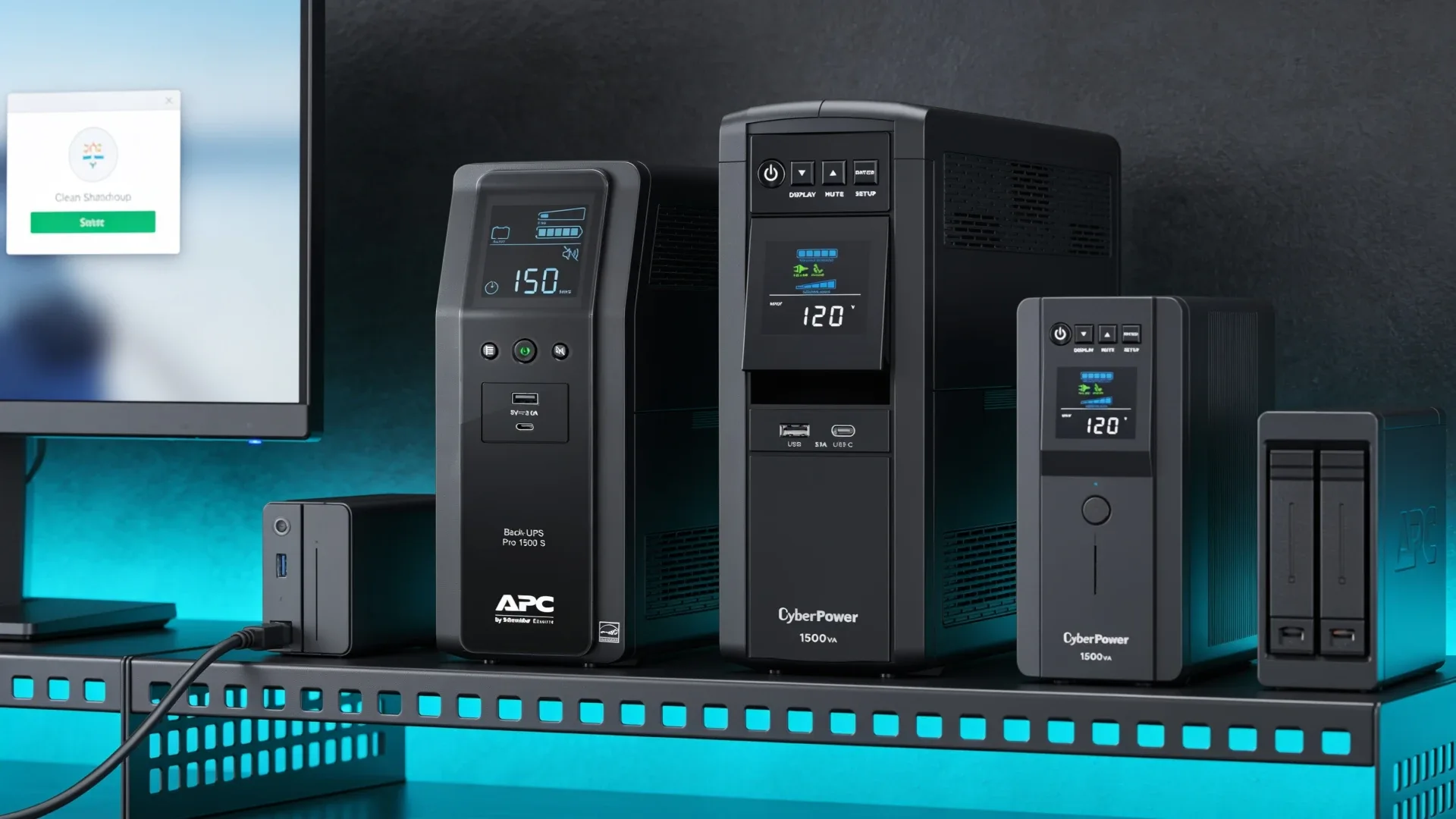
The best UPS for a mini PC home server is not simply the model with the largest VA number. Two details decide whether it belongs in a homelab: the waveform and the shutdown software. Modern mini PCs and NAS boxes often use active-PFC power supplies, which can behave badly when a UPS produces stepped or simulated sine wave output. Proxmox and TrueNAS also need a supported USB driver before they can shut down cleanly.
Choose pure sine wave first. Then size the UPS so your normal load stays below about 70 percent of its watt rating. The UPS sizing calculator turns your mini PC, NAS, switch, and monitor loads into a safer capacity choice.
Quick Picks: Best UPS for a Mini PC Home Server
| Pick | UPS | Best for | Approximate price | Shutdown support | Link |
|---|---|---|---|---|---|
| 🥇 Best Overall | APC Back-UPS Pro BR1500MS2 | APC users and mixed homelabs | ~$280–330 | NUT and apcupsd | Check Current Price |
| 🥈 Best Runtime Value | CyberPower CP1500PFCLCD | Mini PC plus NAS stack | ~$220–270 | NUT | Check Current Price |
| Best Compact Size | CyberPower CP1000PFCLCD | One mini PC and one NAS | ~$160–200 | NUT | Check Current Price |
| Best Small Pure Sine | Eaton 5SC750 | Lower watt loads | ~$300–360 | NUT | Check Current Price |
| Best Tripp Lite Option | Eaton Tripp Lite SMART1500LCDT | Larger mixed loads | ~$280–340 | NUT | Check Current Price |
All five picks use pure sine wave output. All five have a documented NUT path, and the APC model also works with apcupsd. The current stock snapshot shows the APC and CyberPower units sold by Amazon, while the Eaton models use third-party offers. Seller status changes, so check the current listing before ordering.
Why Waveform Matters More Than the Box Label
Pure sine wave output more closely follows utility power. A stepped or simulated sine wave output approximates the shape with a few voltage levels. Many ordinary power supplies tolerate that approximation, but active-PFC supplies can react poorly to it.
The symptom may be noise, a charger that refuses to run, an unexpected transfer to battery, or a UPS that reports an overload even when the load looks reasonable. Those behaviors are not guaranteed with every supply, but they are avoidable compatibility risks. A homelab already has enough failure points without adding a questionable waveform between the wall and the server.
This is why the guide excludes APC BE600M1-class units, APC BX850M, the Eaton 5S line, the Tripp Lite OMNI line, and Vertiv Liebert PSA6E models. Those units use stepped or simulated output according to the relevant manufacturer documentation. USB monitoring alone does not make the waveform suitable.
Clean Shutdown Is the Other Half of the Job
A UPS protects equipment only while the battery has energy. A clean-shutdown service turns that remaining energy into a controlled response. The host receives a low-battery or runtime event, tells virtual machines and containers to stop, flushes storage, and powers off before the battery is exhausted.
NUT is the broadest choice for this audience. The Network UPS Tools compatibility list includes the usbhid-ups driver used by the APC, CyberPower, and Tripp Lite models in this guide. Eaton’s 5SC750 has a dedicated 5SC_750 entry. APC hardware also works with apcupsd, which is why the BR1500MS2 is flexible for an APC-only environment.
The driver name is not enough by itself. The UPS must expose its status over USB, the host must keep the connection alive, and the shutdown policy must be configured. Proxmox and TrueNAS can both participate in a clean shutdown plan, but the exact configuration belongs in the companion UPS clean-shutdown guide.
One caveat matters for CyberPower owners. Some CyberPower units can disappear from USB until the driver attaches. Disable USB autosuspend on the host so the UPS monitoring connection stays available. A UPS that cannot report its state is only a battery box, not an automatic shutdown system.
How to Size a UPS for a Mini PC Homelab
VA is not the same as watts. The watt rating is the practical limit for the load, while VA describes apparent power. Use the watt rating when you decide how much equipment to connect.
Keep the normal load below about 70 percent of that watt rating. This leaves room for startup behavior, short spikes, battery aging, and measurement uncertainty. If your mini PC, NAS, and network switch use 300W together, a 600W UPS is the lower edge of the planning range and a 900W or 1000W unit gives more headroom.
List every device that needs to stay up during an outage:
- Mini PC or server
- NAS enclosure and its hard drives
- Network switch
- Router or modem if remote notification matters
- Monitor only if you need to see the shutdown process
- USB hubs and externally powered storage
Do not put a laser printer, heater, speaker amplifier, or other high-draw device on the battery outlets. Use surge-only outlets for equipment that does not need runtime.
Halving the load can yield roughly three to four times the runtime rather than two. That is why a UPS with fewer protected devices can be more useful than a larger UPS carrying every accessory in the room. Five to ten minutes usually covers a clean shutdown on a mini PC homelab. The aim is controlled power-off, not hours of battery operation.
Run your planned devices through the UPS sizing calculator before choosing a VA class. If a manufacturer does not publish a runtime curve for your exact load, say so and plan around shutdown rather than inventing a number.
Our Top Picks: Best Pure Sine Wave UPS Units
🥇 Best Overall
APC Back-UPS Pro BR1500MS2
→ Check Current Price on Amazon
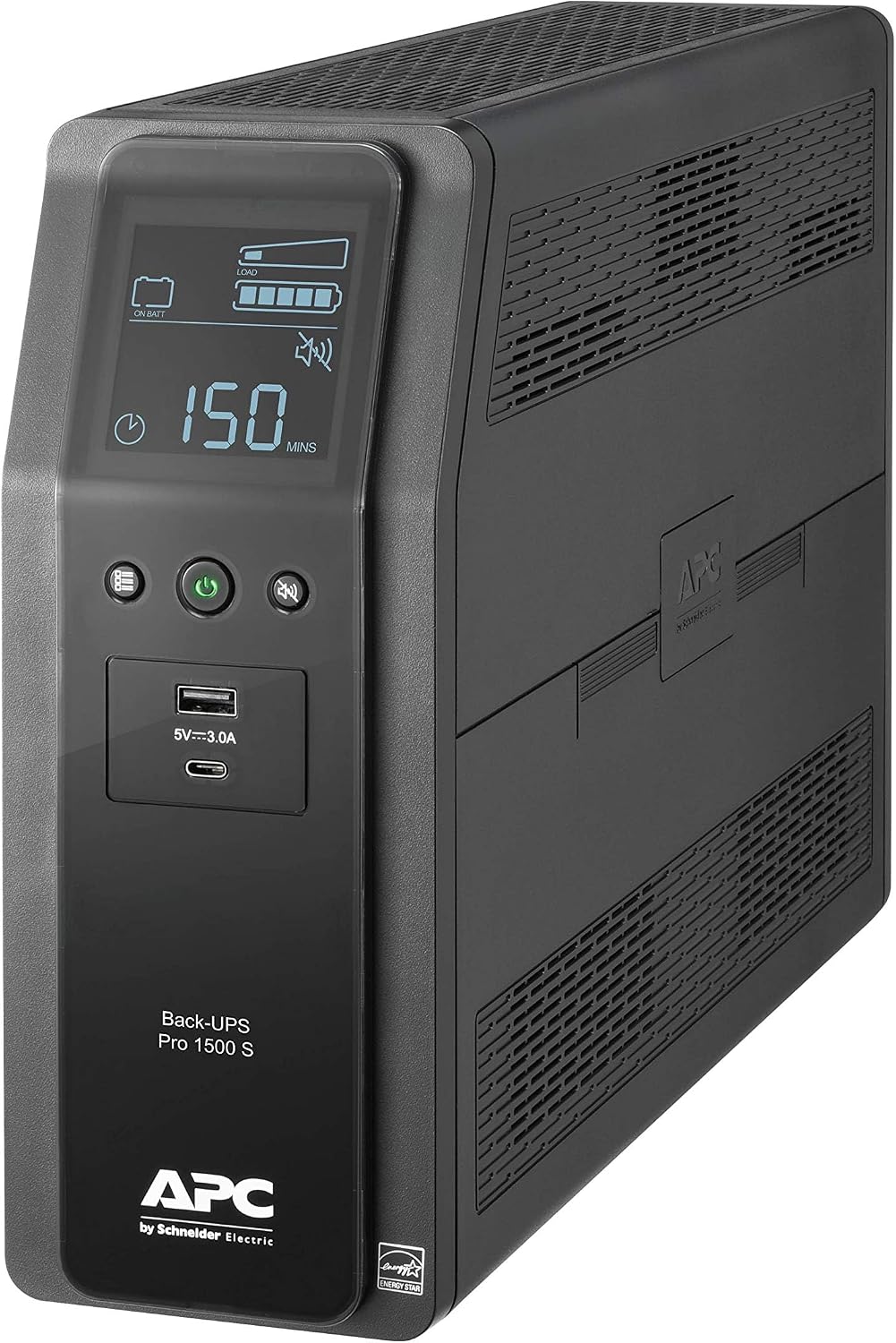
The APC Back-UPS Pro BR1500MS2 is the safest all-around choice when you want both NUT and apcupsd options. APC lists it as a 1500VA and 900W pure sine wave UPS with four battery-backed outlets and six surge-only outlets. The battery is replaceable, which matters for a homelab expected to stay in service for several years.
The APC choice is especially useful for a small Proxmox host, a NAS, and network gear when you want a mainstream APC workflow. NUT’s usbhid-ups driver supports it, and apcupsd is available for APC-only installations. The current listing is available and sold by Amazon in the checked snapshot.
The vendor listing includes a runtime claim at a 100W load, but the broad house rule for this guide is to use the calculator for your own load. Runtime changes with battery age, load, and the exact operating mode.
Specs:
| Spec | Detail |
|---|---|
| Waveform | Pure sine wave |
| Capacity | 1500VA and 900W |
| Battery outlets | 4 |
| Surge-only outlets | 6 |
| Shutdown support | NUT usbhid-ups and apcupsd |
| Battery | Replaceable |
| Runtime | Vendor does not publish a universal figure for every load |
| Price | ~$280–330 |
Pros:
- Pure sine output suits active-PFC mini PCs and NAS boxes
- NUT and apcupsd give you two shutdown paths
- Replaceable battery and 900W capacity fit a growing homelab
Cons:
- Larger than needed for one low-power mini PC
- Higher purchase cost than the 600W class
- Runtime depends on your actual connected load
Who should buy this: Buy it for a mixed homelab with a mini PC, NAS, switch, router, and room for future expansion.
Who should skip this: Skip it if your protected load is one mini PC and one small NAS under the 600W planning tier. CyberPower CP1000PFCLCD is a smaller fit.
🥈 Best Runtime Value
CyberPower CP1500PFCLCD
→ Check Current Price on Amazon
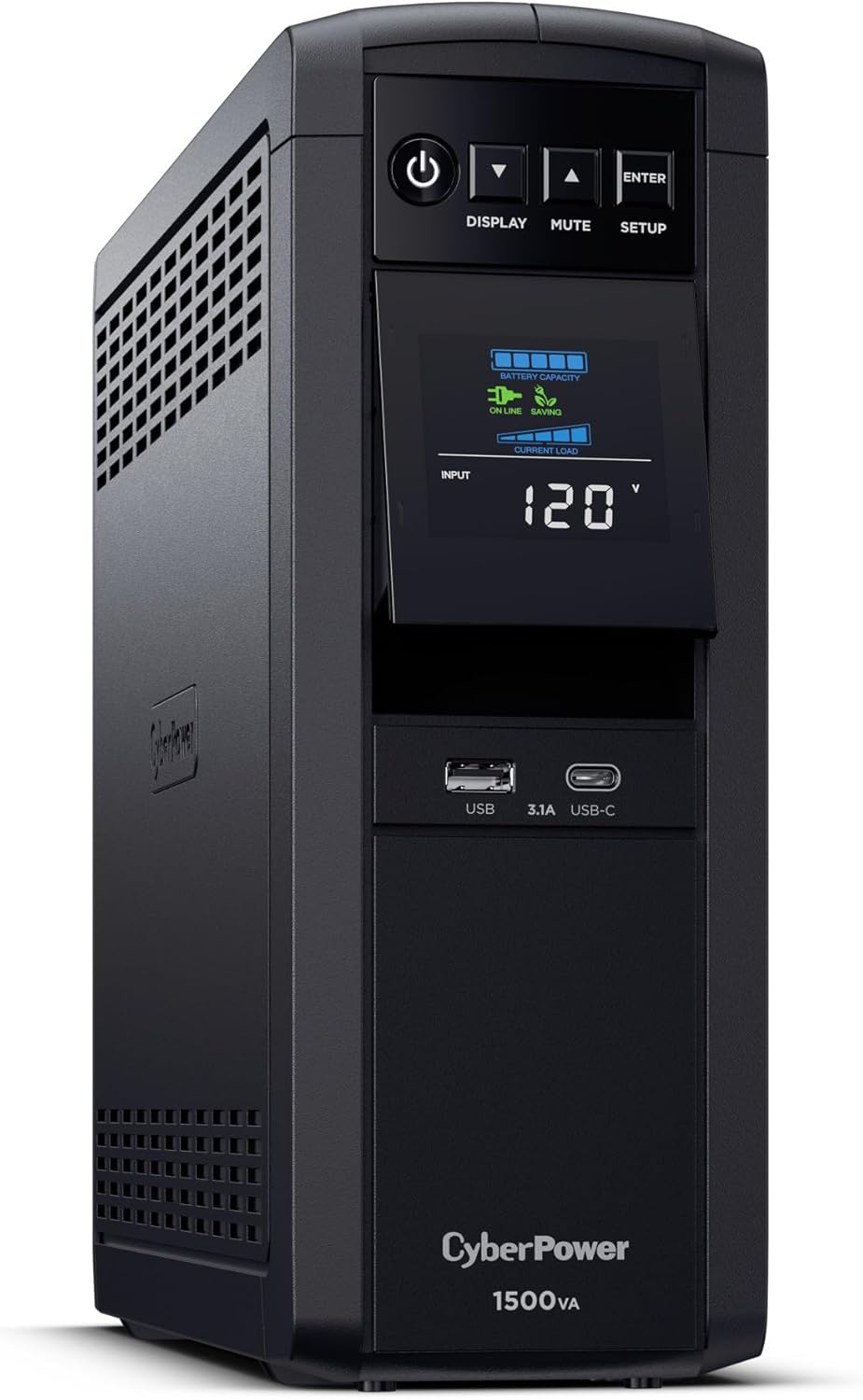
The CyberPower CP1500PFCLCD is a 1500VA and 1000W pure sine wave unit marketed as PFC Sinewave. It has an official NUT usbhid-ups entry and PowerPanel software for Linux. That combination makes it a strong match for a mini PC server and NAS stack where a clean shutdown is more important than keeping the system online through a long outage.
CyberPower’s vendor calculator publishes about 66 minutes at a 100W load for this model. That is the only runtime number in this article presented as a product-specific vendor figure. Your load will be higher if the NAS disks, switch, or monitor are connected, and battery age changes the result.
The current listing is available and sold by Amazon in the checked snapshot. CyberPower USB autosuspend remains the main integration caveat. Disable autosuspend so NUT can keep talking to the UPS.
Specs:
| Spec | Detail |
|---|---|
| Waveform | Pure sine wave marketed as PFC Sinewave |
| Capacity | 1500VA and 1000W |
| Shutdown support | NUT usbhid-ups and PowerPanel for Linux |
| Battery | Replaceable |
| Runtime | About 66 minutes at 100W from the vendor calculator |
| Price | ~$220–270 |
Pros:
- Highest watt rating among the compact CyberPower picks
- Vendor runtime calculator gives a useful 100W reference point
- NUT support and Linux software fit a homelab host
Cons:
- USB autosuspend can interrupt monitoring
- A 1000W unit is unnecessary for a very small load
- Vendor runtime figures do not transfer directly to your setup
Who should buy this: Buy it for a mini PC, NAS, and network stack when you want 1000W of pure sine headroom and NUT support.
Who should skip this: Skip it if the load is light and you want the smallest enclosure. The CP1000PFCLCD is easier to size for one mini PC and one NAS.
Best Compact Size
CyberPower CP1000PFCLCD
→ Check Current Price on Amazon
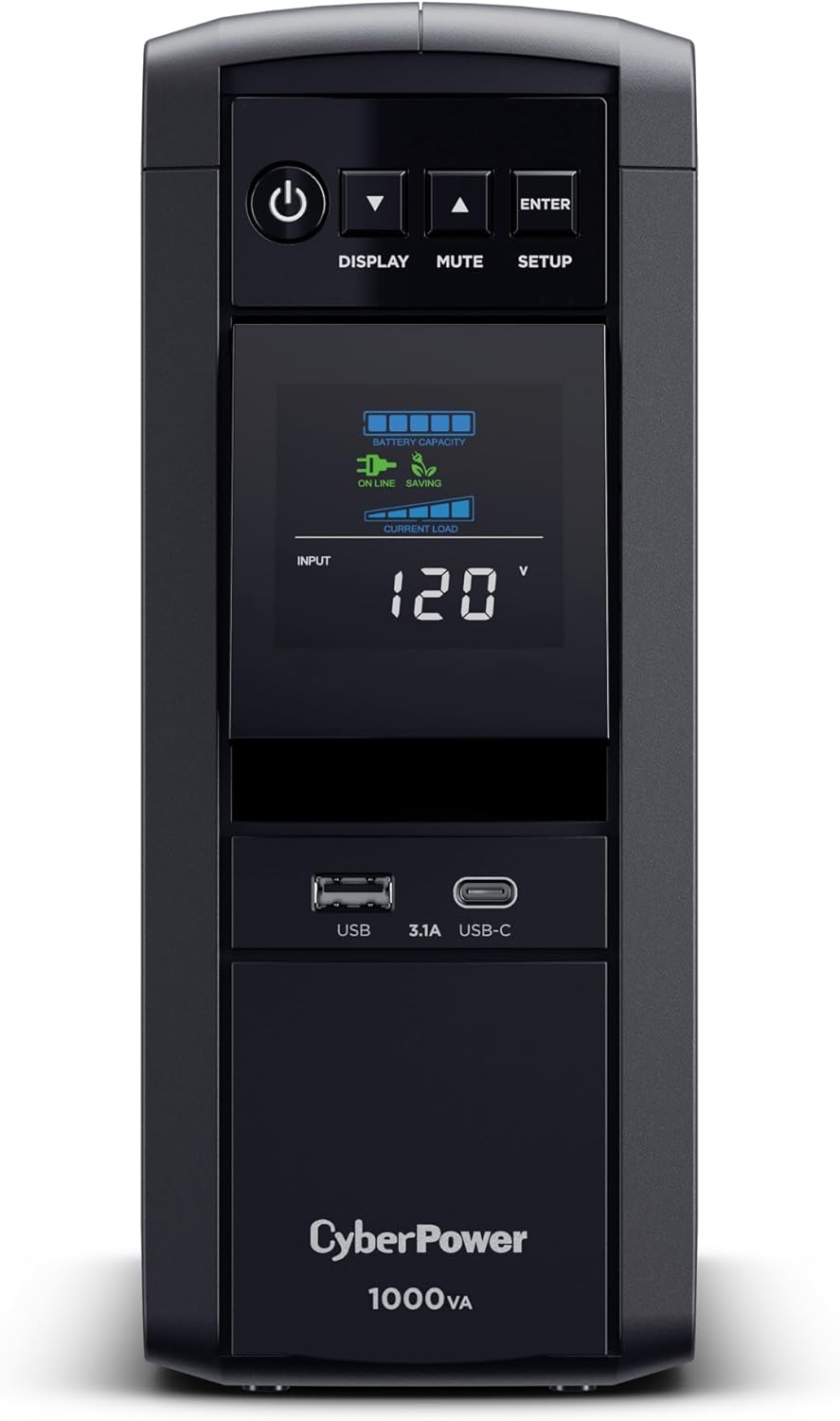
The CP1000PFCLCD is the compact CyberPower option. It provides 1000VA and 600W of pure sine output, has an official NUT usbhid-ups entry, and uses a replaceable battery. That is enough planning capacity for one mini PC, one modest NAS, and network gear when the calculated load stays well below the 600W ceiling.
Its limitation is capacity, not compatibility. Do not choose it for a stack that includes several disk shelves or power-hungry monitors. Keep the normal load below about 70 percent of 600W and use the calculator before you add equipment.
The current listing is available and sold by Amazon in the checked snapshot. As with the larger CyberPower unit, disable USB autosuspend on a Linux host so NUT can monitor it continuously. The vendor does not publish a universal runtime figure that applies to every load.
Specs:
| Spec | Detail |
|---|---|
| Waveform | Pure sine wave |
| Capacity | 1000VA and 600W |
| Shutdown support | NUT usbhid-ups |
| Battery | Replaceable |
| Runtime | Vendor does not publish a universal figure for every load |
| Price | ~$160–200 |
Pros:
- Pure sine output in a smaller capacity class
- NUT support is documented
- Right-sized for a single mini PC and small NAS
Cons:
- 600W limits future expansion
- USB autosuspend needs attention on Linux
- No product-specific runtime figure is used here
Who should buy this: Buy it for a low-power mini PC server, one NAS, and network equipment with a calculated load comfortably below 600W.
Who should skip this: Skip it if you plan to add multiple drive shelves, a workstation, or several displays. The APC or CP1500PFCLCD gives more headroom.
Best Small Pure Sine
Eaton 5SC750
→ Check Current Price on Amazon
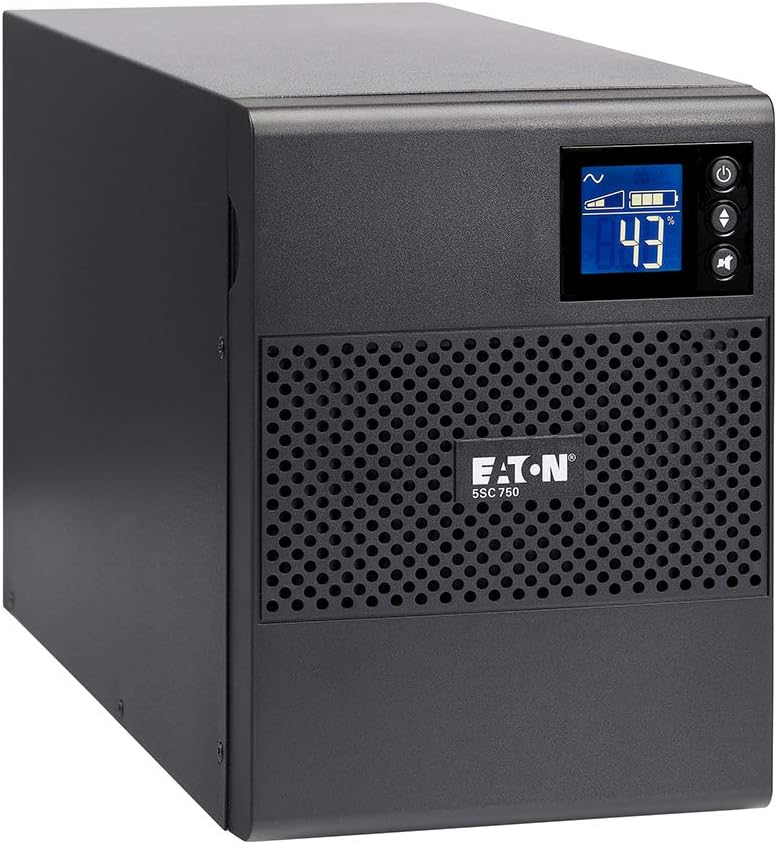
The Eaton 5SC750 provides 750VA and 525W of pure sine output. The NUT hardware list includes the 5SC_750 driver entry. It is a good fit when the load is above a small 600W unit’s comfortable range but below the larger 900W class.
The tradeoff is price. The current offer is expensive per watt against the CyberPower models, and the listing has a thin review history. Eaton’s pure sine specification and NUT entry are the reasons it remains a valid specialist pick, not a value leader.
The vendor does not publish a universal runtime figure for every load. Use the calculator and plan for a clean shutdown instead of assuming a particular number of minutes.
Specs:
| Spec | Detail |
|---|---|
| Waveform | Pure sine wave |
| Capacity | 750VA and 525W |
| Shutdown support | NUT 5SC_750 |
| Battery | Check current replacement-battery terms |
| Runtime | Vendor does not publish a universal figure for every load |
| Price | ~$300–360 |
Pros:
- Pure sine output and a dedicated NUT entry
- 525W fits a modest server stack
- Eaton documentation makes the waveform clear
Cons:
- Expensive for the available wattage
- Limited review history in the current listing
- Runtime is not published as a universal figure
Who should buy this: Buy it when you want Eaton hardware, pure sine output, and a 525W NUT-supported capacity tier.
Who should skip this: Skip it if price per watt matters most. CyberPower CP1000PFCLCD or CP1500PFCLCD usually gives a simpler value calculation.
Best Tripp Lite Option
Eaton Tripp Lite SMART1500LCDT
→ Check Current Price on Amazon
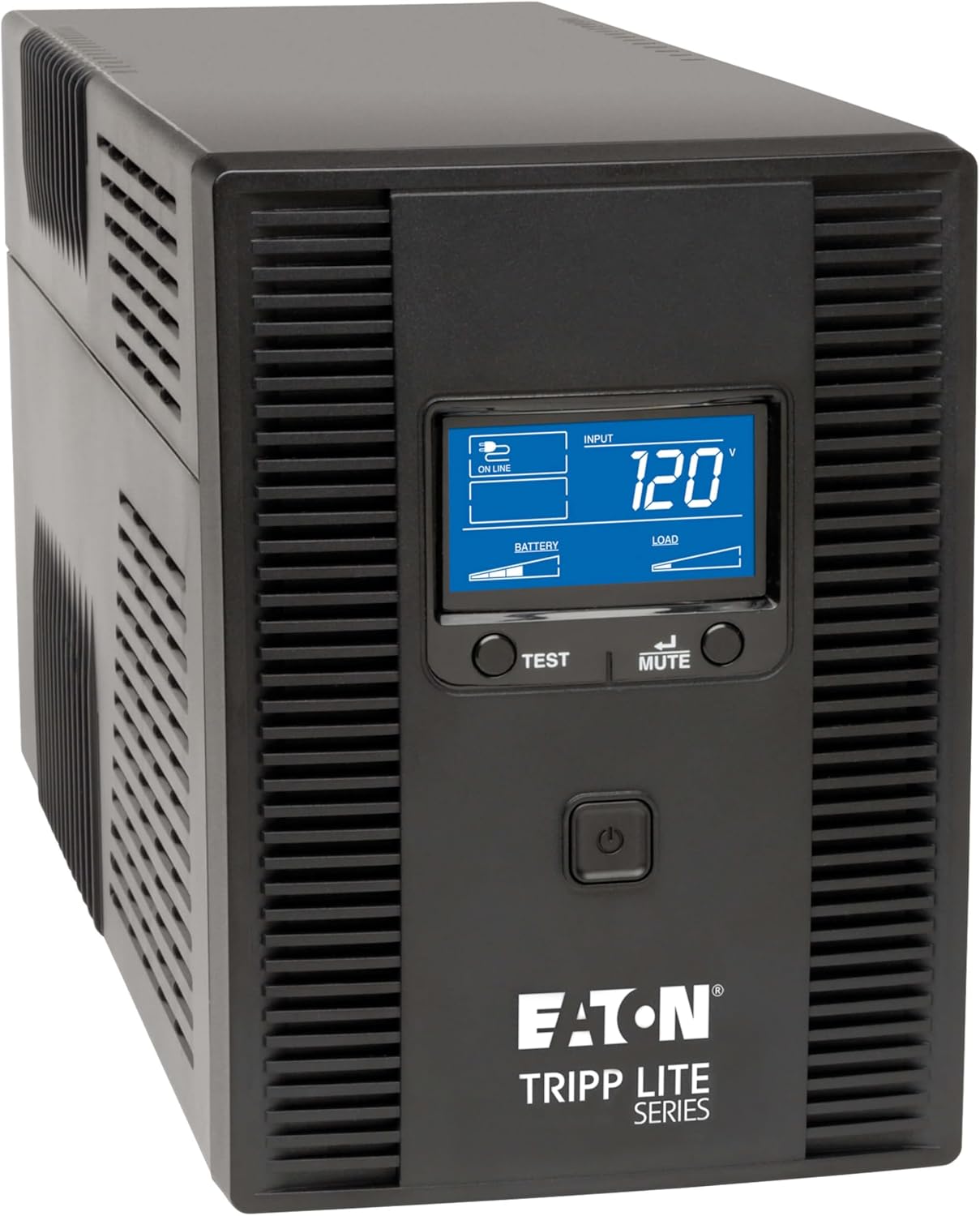
The Eaton Tripp Lite SMART1500LCDT is a 1500VA and 900W pure sine wave UPS according to the manufacturer’s data sheet. The NUT hardware list uses the usbhid-ups path. It is the Eaton Tripp Lite choice for a larger mini PC homelab that needs 900W of headroom but does not need double-conversion hardware.
Current NUT versions address the historical crash issue associated with older configurations. Keep the host software current and verify the USB driver before trusting the shutdown path. The vendor does not publish a universal runtime figure for every load.
The listing is available and sold by Amazon in the current snapshot. Check the exact model because nearby Tripp Lite OMNI units are stepped wave and do not belong in this guide.
Specs:
| Spec | Detail |
|---|---|
| Waveform | Pure sine wave per the manufacturer data sheet |
| Capacity | 1500VA and 900W |
| Shutdown support | NUT usbhid-ups |
| Battery | Replaceable |
| Runtime | Vendor does not publish a universal figure for every load |
| Price | ~$280–340 |
Pros:
- 900W pure sine capacity for a larger homelab
- NUT support is documented
- Replaceable battery supports long service life
Cons:
- Historical NUT issues make current software important
- More capacity than a low-power mini PC needs
- Nearby OMNI models use the wrong waveform
Who should buy this: Buy it for a 900W-class mixed homelab with a mini PC, storage, network gear, and moderate expansion plans.
Who should skip this: Skip it if you want the simplest low-power setup or the lowest purchase cost. CP1000PFCLCD is easier to size for a small stack.
Stepped Wave Units We Excluded
These models are named so you can recognize the common traps. They are not recommendations.
- APC BE600M1-class units and APC BX850M use stepped output. The current listing identity for one BE-class configuration is not stable enough to attach a specific model number.
- Eaton 5S models use simulated sine wave output. The 5SC750 above is a different pure sine family.
- Tripp Lite OMNI models use stepped or PWM-stepped output. Do not substitute one for the SMART1500LCDT.
- Vertiv Liebert PSA6E models are simulated sine wave according to Vertiv’s own user guide. The PSA6E line is excluded even when the VA rating looks attractive.
USB support does not override waveform risk. If a UPS has the wrong output for an active-PFC supply, NUT compatibility only makes it easier to monitor the wrong unit.
A Practical Homelab UPS Plan
Connect the mini PC, NAS, and network switch to battery-backed outlets. Put nonessential displays and accessories on surge-only outlets. Connect the UPS USB cable to the host that controls the shutdown decision. Then verify three events before you trust the setup:
- The host sees the UPS model and battery state.
- A simulated power-loss event reaches the shutdown service.
- The server and NAS stop cleanly before the battery reaches its low threshold.
The UPS clean-shutdown guide covers Proxmox and TrueNAS configuration. Use the UPS sizing calculator first so the shutdown timer is based on a realistic load and not the number printed on the front of the box.
Related Reading
Sizing is the half of this decision a table cannot answer, so put your own equipment into the UPS sizing calculator. For the machines that sit behind the battery, see our home server picks and the NAS mini PC roundup, and the mini PC power consumption guide covers what those machines actually draw, which is the number this whole calculation depends on.
How We Research These Picks
We checked the current listings for model identity, availability, seller status, waveform, and capacity on August 25, 2026. We cross-checked the waveform and capacity against manufacturer documentation, and we checked NUT or apcupsd support against the relevant compatibility documentation. Runtime figures are omitted unless the vendor publishes a specific load reference.
No UPS testing, runtime measurements, or electrical measurements are claimed here. The vendor does not publish a universal runtime figure for the APC, CP1000PFCLCD, Eaton 5SC750, or SMART1500LCDT picks. The CyberPower CP1500PFCLCD figure is the vendor’s published estimate at 100W, not a Mini PC Lab measurement.
Frequently Asked Questions
Does a home server need a pure sine wave UPS?
Pure sine wave is the safe default for a home server because active-PFC power supplies can behave poorly on stepped or simulated output. A UPS also needs USB monitoring support so Proxmox or TrueNAS can shut down before the battery is empty.
What is the best UPS for Proxmox and TrueNAS?
The best choice depends on the load and the shutdown software. APC BR1500MS2 supports NUT and apcupsd, while CyberPower and Eaton picks in this guide use NUT. Choose the smallest pure sine model that keeps the normal load below about 70 percent of its watt rating.
How large should a UPS be for a mini PC and NAS?
Keep the normal load below about 70 percent of the UPS watt rating. A single mini PC and small NAS often fit the 600W class, while several disks, a switch, and monitors need more headroom. Use the UPS sizing calculator with the wattage of every device you plan to protect.
How many minutes of UPS runtime does a server need?
Five to ten minutes usually gives a mini PC homelab enough time to shut down cleanly. Longer runtime is useful only when you need to ride through short outages or keep network equipment online. The CyberPower CP1500PFCLCD vendor calculator publishes about 66 minutes at a 100W load.
Is NUT better than apcupsd for a homelab UPS?
NUT supports a wide range of UPS brands and is the usual choice for CyberPower and Eaton units. apcupsd is designed for APC hardware. Both can support clean shutdown when the driver, USB connection, and host configuration are correct.
Why are simulated sine wave UPS units excluded?
Stepped or simulated sine wave units can cause active-PFC power supplies to buzz, switch to battery unexpectedly, or fail to transfer cleanly. They may work with some ordinary loads, but a homelab has enough sensitive electronics that pure sine wave is the safer recommendation.