
This article contains affiliate links. If you purchase through our links, we may earn a commission at no extra cost to you. We only recommend products we’ve thoroughly researched and verified.
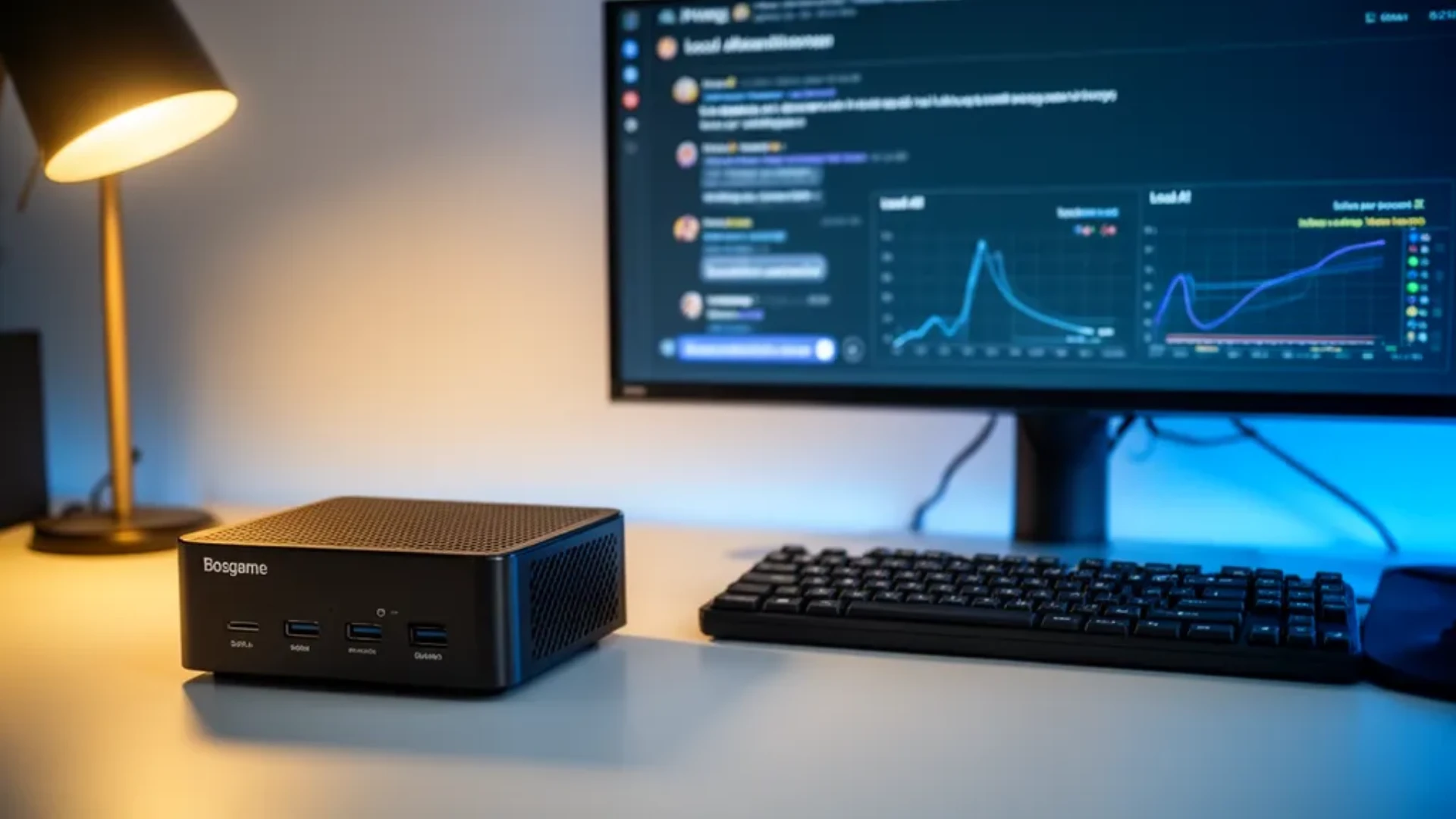
The Bosgame M5 is another entry in the wave of Strix Halo mini PCs built around AMD’s Ryzen AI Max+ 395, the chip that put 128GB of unified memory and real local-LLM capability into a box you can hold in one hand. It arrives into a crowded field led by the GMKtec EVO-X2 and Beelink GTR9 Pro, so the question is not whether it runs 70B models, since it does, but whether it earns your money over the boxes people already know. Here is the honest review, with the price reality up front.
We verified the configuration and price through the Amazon product data on July 12, 2026 and drew local-AI performance from community Ollama runs on this platform rather than a bench session of our own.
Bosgame M5 — Specs at a Glance
| Spec | Detail |
|---|---|
| CPU | AMD Ryzen AI Max+ 395, 16-core, 32-thread, Strix Halo |
| GPU | Radeon 8060S, RDNA 3.5 |
| NPU | XDNA 2, around 50 TOPS |
| Memory | 128GB LPDDR5X 8000MHz, soldered, roughly 256 GB/s |
| Storage | 2TB PCIe 4.0 M.2 SSD |
| Connectivity | USB4, WiFi |
| Price | ~$3,299 for 128GB and 2TB |
| Best for | Running 70B local models in a small box |

Port layout from BOSGAME’s own listing diagram, showing the front I/O cluster and the rear panel.
Performance: A 70B Model in a Small Box
The Bosgame M5’s reason to exist is unified memory. Because the CPU, GPU, and NPU share up to 128GB of LPDDR5X, it can load a 70B model in 4-bit quantization, which needs about 40GB, and still leave room for the operating system and containers. A 16GB or 24GB graphics card cannot hold that model at all, which is the whole appeal of the Strix Halo platform. Our best mini PC for local LLM guide maps model sizes to the memory you need.
On speed, community Ollama runs on the Ryzen AI Max+ 395 land in a consistent range: a 70B Q4 model around 18 to 22 tokens per second, an 8B model much faster, and a 32B model in between. Treat those as community estimates, since quantization, cooling, and driver version all move the number. The Radeon 8060S graphics doubles the M5 as a creative and light gaming box, generating Stable Diffusion XL images in seconds and handling 1080p titles at medium to high settings.
The Two Limits Every Strix Halo Buyer Should Know
The M5 shares the platform’s two honest limits, and knowing them prevents disappointment:
- Bandwidth is the ceiling. At roughly 256 GB/s the M5 sits below Apple’s Mac Studio and far below a discrete graphics card. That barely matters for short chat prompts, where it feels quick, but it matters for long-context work, document-heavy retrieval, and coding agents, where prompt processing is bandwidth-bound and slower.
- The NPU needs the right software. The XDNA 2 NPU is rated around 50 TOPS, but plain Ollama ignores it and runs on the CPU and integrated GPU. AMD’s Lemonade SDK is the project that actually uses the NPU, so the headline TOPS figure only pays off with the right stack.
Neither is a flaw unique to Bosgame. They are true of every Ryzen AI Max+ 395 machine, and the M5 is neither better nor worse than its rivals here.
The Price Reality
This is the part that decides the purchase. The Bosgame M5’s 128GB and 2TB configuration lists around 3,299 dollars, which places it right alongside the GMKtec EVO-X2 rather than undercutting it. Early coverage framed the M5 as a value Strix Halo box, but at this price it is not a budget entry, it is a full-price competitor. The 96GB configuration is the one to check if you want to spend less, and it is enough for many 70B workloads at tighter quantization.
Prices across all Strix Halo boxes have moved sharply with LPDDR5 supply through 2026, so the current listing is what matters, not any launch figure. Model your running cost with our power cost calculator, since these machines can draw near 140 watts under sustained inference load.
How It Compares
The M5’s closest rivals are the two most-recommended Strix Halo boxes. The GMKtec EVO-X2 uses the same chip and 128GB memory, ships assembled with a bundled SSD, and is the more widely reviewed unit, which our GMKtec EVO-X2 AI review covers in detail. The Beelink GTR9 Pro matches the chip and memory while running quieter and adding dual 10GbE. Against those, the Bosgame M5 needs to win on current price, the specific configuration you want, cooling noise, or warranty terms, because raw performance is a wash across the platform.
That is not a knock on the M5. It is a capable machine on identical silicon. It simply competes in a field where the differentiators are price and details rather than speed, so shop the exact config and the day’s price. Our best AI mini PC guide ranks the whole category.
Who Should Buy the Bosgame M5?
Buy it if you:
- Want to run 70B local models and the M5 config beats its rivals on price that day
- Need 128GB of unified memory and a 2TB SSD in one box
- Prefer the Bosgame configuration, cooling, or warranty over the alternatives
- Understand the bandwidth and NPU-software limits of the platform
Skip it if you:
- Can get the EVO-X2 or GTR9 Pro cheaper or with better terms
- Want upgradeable memory, which no Strix Halo box offers
- Only run models up to 32B, where a cheaper 64GB or 96GB machine fits
- Depend on an external AMD graphics card, given the platform’s 120-watt eGPU cap
Frequently Asked Questions
Is the Bosgame M5 good for local LLMs?
Yes. The Bosgame M5 uses the Ryzen AI Max+ 395 with 128GB of unified memory, which lets it load a 70B model in 4-bit quantization that a normal graphics card cannot hold. Community Ollama runs on this platform put a 70B Q4 model around 18 to 22 tokens per second. The limit to understand is memory bandwidth near 256 GB/s, which makes long prompts slower than a discrete GPU.
How much does the Bosgame M5 cost?
The 128GB and 2TB configuration is listed around 3,299 dollars, which places it alongside the GMKtec EVO-X2 rather than below it. The lower-memory 96GB configuration is the one to check for a better price. All Strix Halo boxes have swung in price with LPDDR5 supply, so confirm the current listing before you buy.
Bosgame M5 or GMKtec EVO-X2?
Both use the same Ryzen AI Max+ 395 and 128GB memory, so local-AI performance is close. Compare them on the config you want, the current price, cooling noise, and warranty terms rather than raw speed. The EVO-X2 is the more widely reviewed box, so the Bosgame M5 needs to win on price or a specific configuration to be the better buy on any given day.
Does the Bosgame M5 have upgradeable memory?
No. The 128GB LPDDR5X memory is soldered, because the Ryzen AI Max+ 395 needs soldered memory to reach its roughly 256 GB/s bandwidth. Buy the capacity you need up front. If you plan to run 70B models, the 128GB configuration is the one to get, since there is no way to add memory later.
Can the Bosgame M5 run Stable Diffusion and gaming?
Yes. The Radeon 8060S integrated graphics sits between an RTX 4060 and RTX 4070 laptop GPU, generates Stable Diffusion XL images in seconds, and handles 1080p gaming at medium to high settings. Its real strength is unified memory for large language models, but it doubles as a capable creative and light gaming machine.
Does the Bosgame M5 use its NPU for AI?
Only with the right software. The Ryzen AI Max+ 395 includes an XDNA 2 NPU rated around 50 TOPS, but plain Ollama ignores it and runs on the CPU and integrated GPU. AMD’s Lemonade SDK is the path that actually uses the NPU. If the NPU is a reason you are buying, plan to run Lemonade rather than assuming every tool taps it.
How We Research These Picks
We verified the Bosgame M5 configuration, price, and availability against the Amazon product data on July 12, 2026, confirming the 128GB and 2TB listing near 3,299 dollars, and we drew local-AI token-speed ranges from community Ollama runs on the Ryzen AI Max+ 395 rather than a bench session of our own. We flag that the M5 is priced with the EVO-X2 rather than below it, because early framing suggested otherwise. Every figure here carries its source, and we make no hands-on testing claim we did not perform.
Amazon Product Links
- Bosgame M5 — 128GB Strix Halo for local AI: Check Current Price