
Apple vs x86 for Local AI: Mac Mini M4 Pro vs Strix Halo Mini PCs
By Max · September 21, 2026
This article contains affiliate links. If you purchase through our links, we may earn a commission at no extra cost to you. We only recommend products we’ve thoroughly researched and verified.
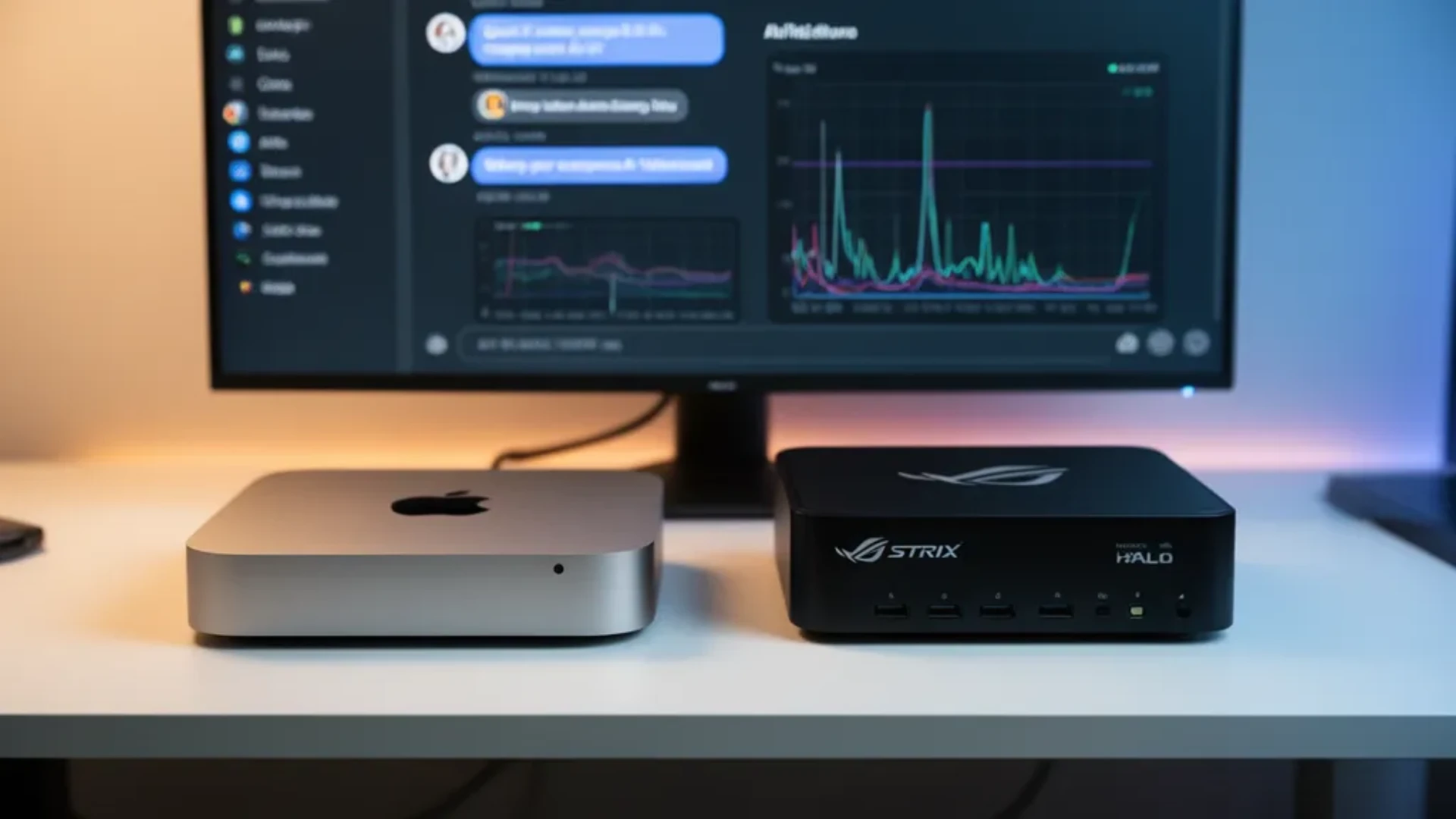
The two ways to run a big local model on a small desktop in 2026 are an Apple Mac Mini M4 Pro and an x86 Strix Halo mini PC built on the Ryzen AI Max+ 395. Both use unified memory, so the CPU and GPU share one fast pool instead of copying data across a slow bus. That is what lets either of them load a model far larger than a normal graphics card can hold. The differences that decide the purchase are memory ceiling, memory bandwidth, software maturity, and power. Here is the honest breakdown, with numbers from Apple, AMD platform reviews, and community inference runs rather than any bench session of our own.
The Short Answer
Buy a 128GB Strix Halo mini PC like the Beelink GTR9 Pro if your goal is running 70B models with room to spare and you live in Linux and Docker. Buy the Mac Mini M4 Pro if you want the most polished local-AI software stack, the lowest power draw, and macOS, and a 64GB memory ceiling is enough for your models. Token speed on a model that fits both is close, so this comes down to capacity, ecosystem, and efficiency, not raw speed.
Side-by-Side Specs
| Spec | Mac Mini M4 Pro | Beelink GTR9 Pro |
|---|---|---|
| Chip | Apple M4 Pro | Ryzen AI Max+ 395 |
| Max unified memory | 64GB | 128GB |
| Memory bandwidth | ~273 GB/s | ~256 GB/s |
| Software | MLX, Metal, Ollama | ROCm, Lemonade, Ollama |
| Networking | Up to 10GbE option | Dual 10GbE |
| External I/O | Thunderbolt 5 | Dual USB4 |
| Idle power | Very low | ~12W platform |
| Cost per GB of memory | Higher | Lower |
| Operating system | macOS | Linux or Windows |
Memory Ceiling — The One Spec That Decides Most Purchases
The single biggest difference is how much memory each machine can hold. The Mac Mini M4 Pro tops out at 64GB of unified memory. The Strix Halo boxes reach 128GB. That gap changes which models you can run comfortably.
A 70B model in 4-bit quantization needs roughly 40GB. On a 128GB machine that fits with tens of gigabytes left for the operating system, a vector database, and a few containers. On a 64GB Mac Mini M4 Pro the same model fits only if you raise the default GPU memory limit, and it leaves almost nothing spare. Push to a 70B model in 8-bit, which needs about 75GB, and the Mac cannot hold it at all while the 128GB box still can.
If your work lives at 32B and below, the 64GB Mac Mini M4 Pro has ample room and this gap does not matter. If you specifically bought a small desktop to run 70B-class models, the 128GB ceiling on Strix Halo is the reason to choose it. Our best mini PC for local LLM guide maps model sizes to the memory you need.
Bandwidth and Real Token Speed
Memory bandwidth sets how fast tokens come out once a model is loaded, and here the two are closer than the marketing suggests. Apple rates the M4 Pro around 273 GB/s. The Ryzen AI Max+ 395 runs near 256 GB/s. Those are within striking distance, so a 70B Q4 model that fits both machines generates tokens at a similar pace, in the rough range of 18 to 22 tokens per second based on community Ollama runs.
This is where buyers often get confused by the wrong comparison. The Mac Studio with M4 Max reaches around 546 GB/s and the M3 Ultra around 819 GB/s, which leaves any mini PC far behind. But those are larger, pricier desktops, not the Mac Mini. Against the Mac Mini M4 Pro specifically, Strix Halo is competitive on speed and ahead on capacity.
One shared limit applies to both platforms. Long prompts, document-heavy retrieval, and coding agents lean on prompt processing, which is bandwidth-bound. Neither of these machines matches a discrete graphics card there, so if your workflow is stuffing huge contexts rather than short chats, temper expectations on both.
Software: MLX and Metal vs ROCm and Lemonade
Apple has the more mature local-AI software stack today. MLX is well optimized for Apple Silicon, Metal acceleration is stable, and Ollama uses the GPU automatically with no setup. For a buyer who wants to install one app and start chatting with a local model, the Mac Mini M4 Pro is the smoother path.
The AMD side is improving quickly but sits closer to the frontier. ROCm support for the RDNA 3.5 graphics is stable enough for Ollama and llama.cpp on recent releases, and AMD’s Lemonade SDK is the project that actually uses the XDNA 2 NPU. The catch worth stating plainly: plain Ollama ignores the NPU and runs on the CPU and integrated GPU, so the headline TOPS number only pays off with Lemonade or another NPU-aware stack. If you want Linux, containers, and homelab flexibility, the x86 route rewards you; if you want zero fuss, Apple wins this round.
Power and Running Costs
Apple Silicon is the efficiency champion. The Mac Mini M4 Pro idles very low and stays modest under load, which matters if the machine runs inference for hours every day. The Ryzen AI Max+ 395 platform idles around 12 watts per ServeTheHome and can draw near 140 watts under full inference load per TerminalBytes.
For an always-on assistant that mostly sits idle, both are cheap to run, and you can model your own rate with our power cost calculator. For a machine hammering inference all day, the Mac’s efficiency turns into real savings on the electricity bill over a year. Factor that into the total cost, not just the sticker price.
Cost Per Gigabyte — Where x86 Wins
Capacity is cheaper on the x86 side. A 128GB Ryzen AI Max+ 395 mini PC around 2,800 dollars works out near 22 dollars per gigabyte of fast unified memory. A 64GB Mac Mini M4 Pro around 2,199 dollars is closer to 34 dollars per gigabyte. If the reason you are shopping is raw memory for large models, the Strix Halo boxes give you more of it per dollar, and twice the ceiling.
The honest caveat is price volatility. LPDDR5 supply has pushed Strix Halo street prices up and down through 2026, so check the current listing before you commit. Apple pricing is steadier, which has its own value if you want a predictable number.
Which Should You Buy?
Buy the Beelink GTR9 Pro or another Strix Halo box if you:
- Want to run 70B models with headroom for containers and databases
- Live in Linux and Docker and want homelab flexibility
- Care about cost per gigabyte and the 128GB ceiling
- Want dual 10GbE for fast model and backup transfers
Buy the Apple Mac Mini M4 Pro if you:
- Want the most polished local-AI software with MLX and Metal
- Value the lowest power draw for an always-on assistant
- Work mostly at 32B models and below where 64GB is plenty
- Prefer macOS, Thunderbolt 5, and strong resale value
For the fully assembled x86 options and how they compare on thermals and noise, see our best AI mini PC guide and our GMKtec EVO-X2 AI review.
Frequently Asked Questions
Mac Mini M4 Pro or a Strix Halo mini PC for local LLMs?
Pick the Strix Halo box if you want to run 70B models with headroom, because it reaches 128GB of unified memory versus 64GB on the Mac Mini M4 Pro. Pick the Mac Mini M4 Pro if you value the mature MLX and Metal software stack, lower idle power, and macOS. Token speed on a 70B Q4 model is close between them because their memory bandwidth is similar.
How much unified memory does the Mac Mini M4 Pro have?
The Mac Mini M4 Pro supports up to 64GB of unified memory, with a 24GB base configuration. That is enough for a 70B model in 4-bit quantization if you raise the GPU memory limit, but it leaves little headroom. The 128GB Strix Halo boxes are the choice when you want a 70B model plus containers running at the same time.
Is Apple Silicon faster than Ryzen AI Max+ 395 for LLMs?
For the Mac Mini M4 Pro the two are close. Apple rates the M4 Pro around 273 GB/s of memory bandwidth and the Ryzen AI Max+ 395 runs near 256 GB/s, so token generation on a model that fits both is similar. The Mac Studio with M4 Max or M3 Ultra pulls far ahead on bandwidth, but those cost more and are not mini PCs.
Which is cheaper per gigabyte of fast memory?
The Strix Halo boxes win on cost per gigabyte. A 128GB Ryzen AI Max+ 395 mini PC around 2,800 dollars works out near 22 dollars per gigabyte, while a 64GB Mac Mini M4 Pro around 2,199 dollars is closer to 34 dollars per gigabyte. If raw capacity for large models is the goal, x86 unified memory is the value play.
Does the Mac Mini run Ollama for local AI?
Yes. Ollama runs well on Apple Silicon and uses the GPU through Metal automatically. MLX is the other strong option and is well optimized for Apple hardware. On the AMD side, Ollama works through ROCm, and AMD’s Lemonade SDK is the path that also uses the NPU. Both platforms are production-ready for local inference in 2026.
Which uses less electricity, Apple or Strix Halo?
Apple Silicon is the efficiency winner. The Mac Mini M4 Pro idles very low and sips power under load. The Ryzen AI Max+ 395 platform idles around 12 watts and can draw near 140 watts under full inference load. If a machine runs inference for hours every day, the Mac’s efficiency shows up on the electricity bill.
How We Research These Picks
We cross-checked memory ceilings and bandwidth against Apple’s published specifications and AMD platform reviews, drew token-speed ranges from community Ollama runs rather than a bench session of our own, and attributed power figures to ServeTheHome for platform idle and TerminalBytes for load. Prices reflect current listings, and we flag where LPDDR5 supply is moving Strix Halo street prices. Every performance figure here carries its source, and we make no hands-on testing claim we cannot back up.
Amazon Product Links
- Beelink GTR9 Pro — the 128GB x86 pick: Check Current Price
- Apple Mac Mini M4 Pro — the efficient Apple pick: Check Current Price