
This article contains affiliate links. If you purchase through our links, we may earn a commission at no extra cost to you. We only recommend products we’ve thoroughly researched and verified.
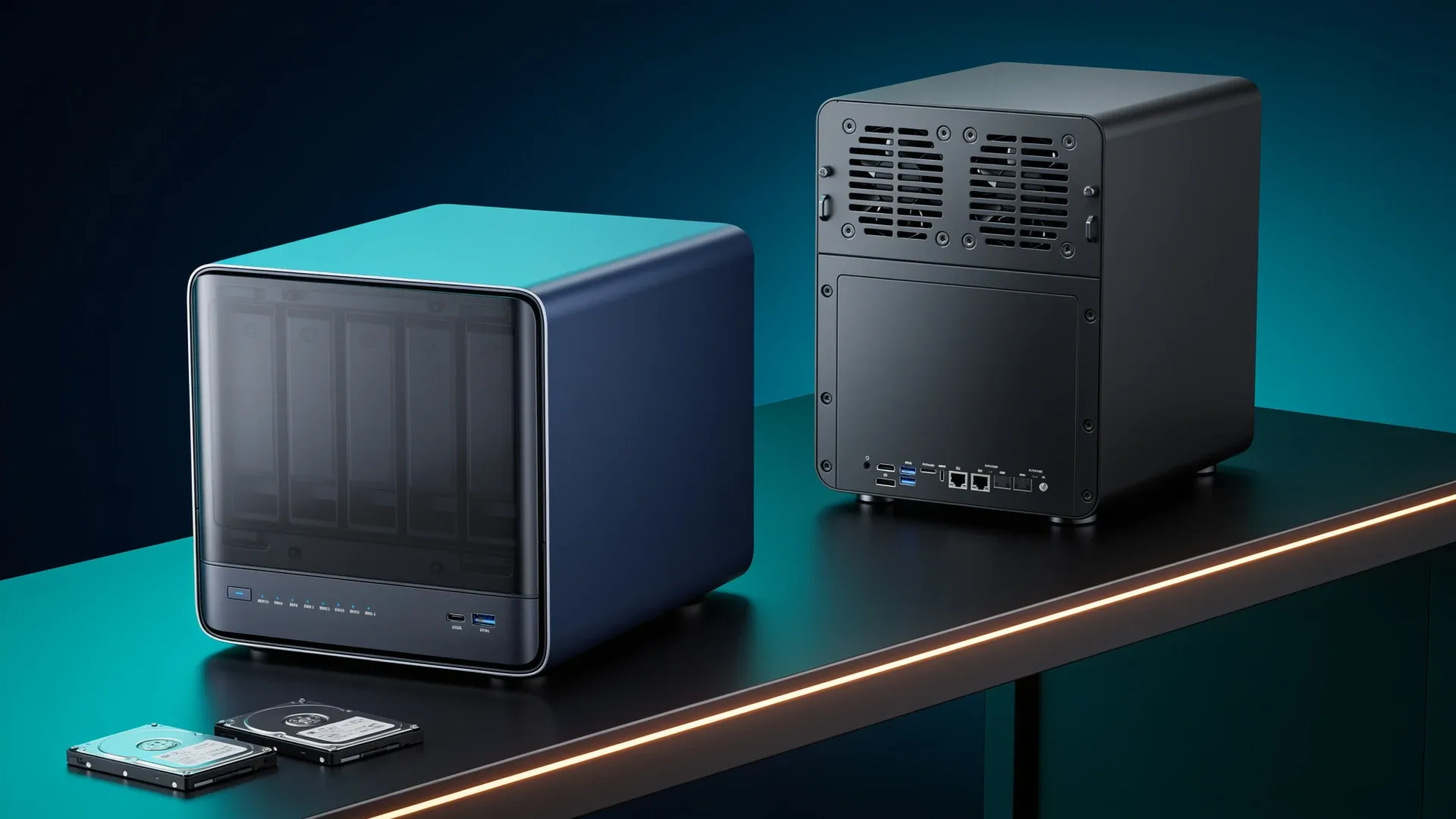
Quick price check: N5 Max 64GB · AOOSTAR WTR Max barebone
The AOOSTAR WTR Max is the better storage-first buy. It gives you six SATA bays, five M.2 positions, upgradeable ECC-capable memory, dual 10GbE, and OCuLink for a fraction of the N5 Max platform price. The MINISFORUM N5 Max makes sense only when one box must be both a five-bay NAS and a serious local-AI workstation.
This comparison uses the exact 64GB N5 Max and Ryzen 7 PRO 8845HS WTR Max barebone listings validated through Amazon product data on August 10, 2026. We did not test either machine. Retail prices are a dated decision input, not a permanent specification.
The short answer
| Buyer | Better choice | Why |
|---|---|---|
| TrueNAS or Unraid storage-first build | AOOSTAR WTR Max | More HDD bays, upgradeable ECC-capable RAM, lower platform cost |
| NAS plus large local models | N5 Max | Ryzen AI Max+ 395, Radeon 8060S, unified memory |
| Maximum total internal positions | Tie | Both expose eleven when the N5 Max OS device is counted separately |
| Memory upgrade path | AOOSTAR WTR Max | Two SO-DIMM sockets rather than fixed LPDDR5X |
| Fast external devices | N5 Max | Two USB4 v2 ports |
| Add an external PCIe device | AOOSTAR WTR Max | OCuLink path |
Exact specifications that change the purchase
| Feature | N5 Max 64GB | AMD WTR Max |
|---|---|---|
| Processor | Ryzen AI Max+ 395 | Ryzen 7 PRO 8845HS |
| Graphics | Radeon 8060S | Radeon 780M |
| Memory | Fixed 64GB LPDDR5X unified memory | Two DDR5 SO-DIMM sockets, ECC-capable |
| Hard-drive bays | Five | Six SATA bays |
| M.2 positions | Five plus separate OS storage | Five |
| Networking | Dual 10GbE | Dual 10GbE plus dual 2.5GbE |
| External expansion | Two USB4 v2 ports | OCuLink |
| Power supply | 250W internal | 280W external |
| Validated retail form | 64GB and 128GB OS storage | Barebone with no RAM or SSD |
Why the N5 Max costs so much
The N5 Max is not simply a faster NAS. Its Ryzen AI Max+ 395 combines sixteen CPU cores with Radeon 8060S graphics and a large unified-memory architecture. The validated retail child includes 64GB LPDDR5X and a small OS drive. That platform can keep larger local models in unified memory while storage lives in the five HDD and five M.2 positions.
That capability is valuable only if it replaces another machine. A buyer who otherwise needs a separate Strix Halo AI workstation can justify part of the premium through consolidation. A buyer running file shares, backups, Plex, and ordinary containers cannot. Faster graphics do not make ZFS safer and do not accelerate a hard-drive pool enough to justify the difference.
MINISFORUM markets model throughput figures, but those are vendor claims rather than Mini PC Lab measurements. We do not use them to promise a token rate.
→ Check the N5 Max 64GB configuration
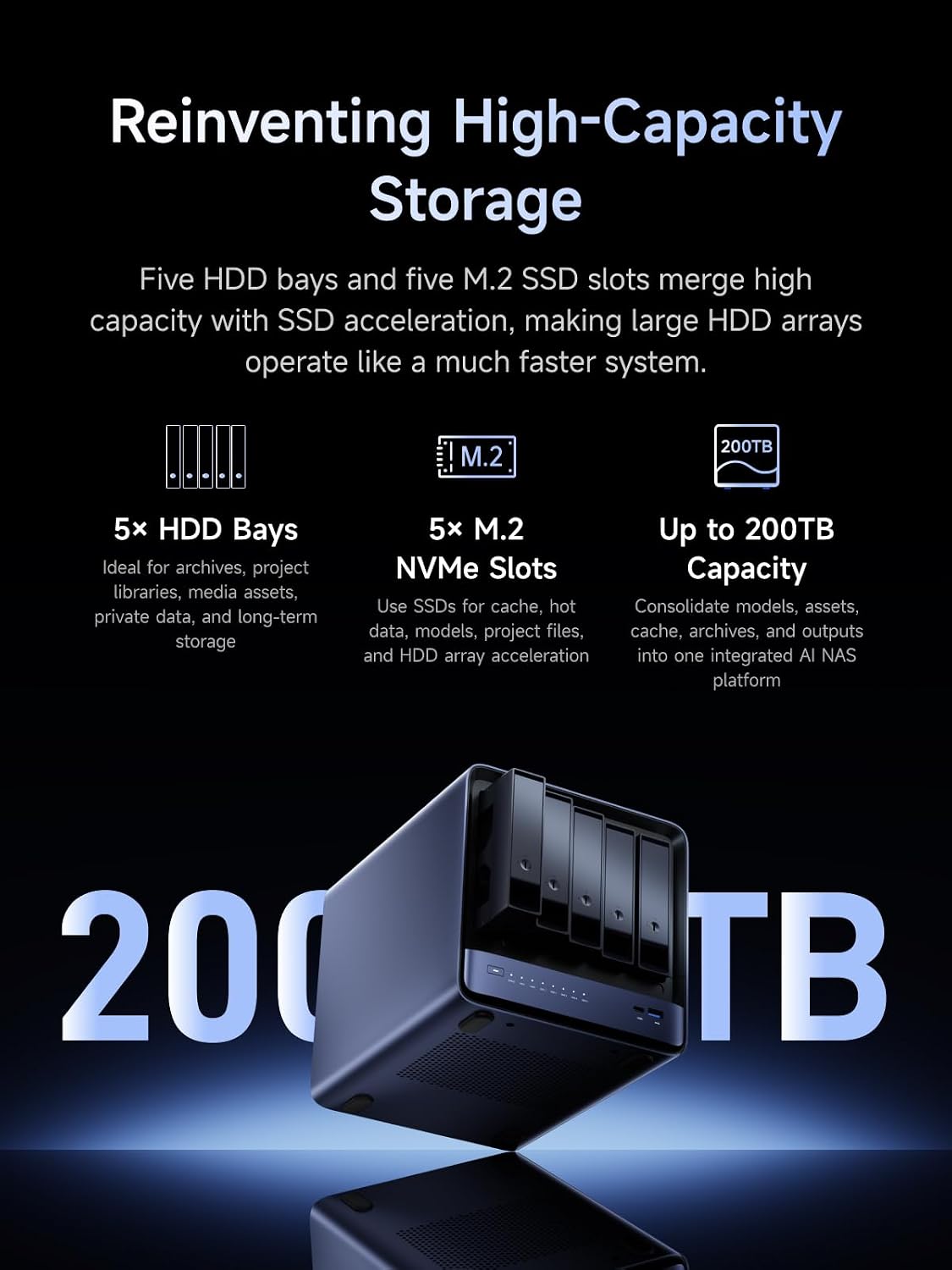
MINISFORUM product material showing the N5 Max hard-drive and M.2 layout.
Why the WTR Max wins for storage
The WTR Max’s Ryzen 7 PRO 8845HS is already ample for storage services, containers, media workloads, and a modest VM stack. More importantly, the chassis directs the budget toward NAS hardware: six SATA bays, five M.2 positions, dual 10GbE, dual 2.5GbE, and an OCuLink connection.
Its two SO-DIMM sockets let a builder select and replace memory. The platform is ECC-capable, which is attractive for ZFS, though buyers must still validate the exact CPU, modules, firmware behavior, and error reporting. ECC reduces one class of memory error; it never replaces backups or tested recovery.
The WTR Max ships barebone in the compared listing. Add RAM and an OS drive before comparing checkout totals. Even after doing that, the price gap leaves room for HDDs, a UPS, a switch, and a backup target.
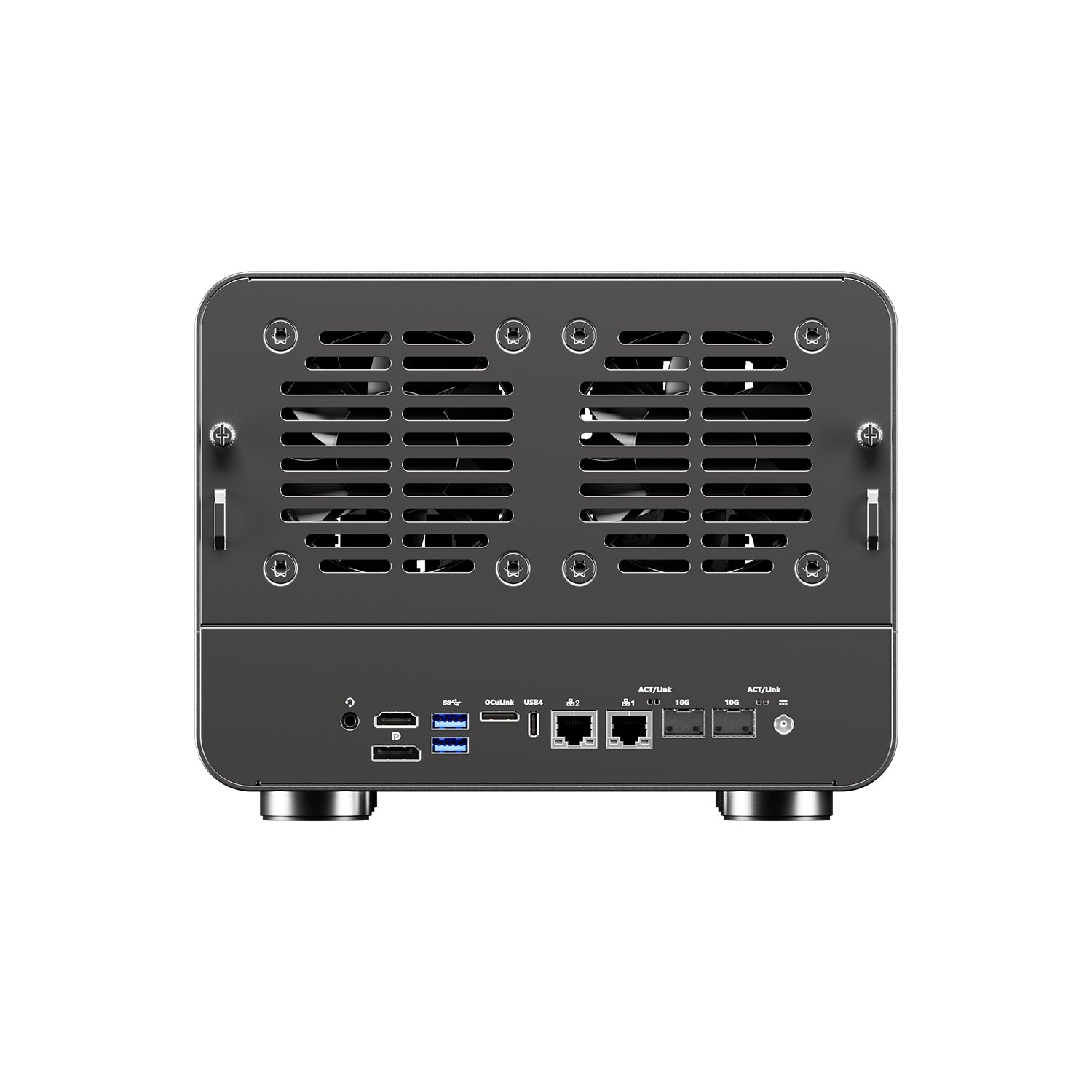
AOOSTAR product image showing the WTR Max rear cooling and network connections.
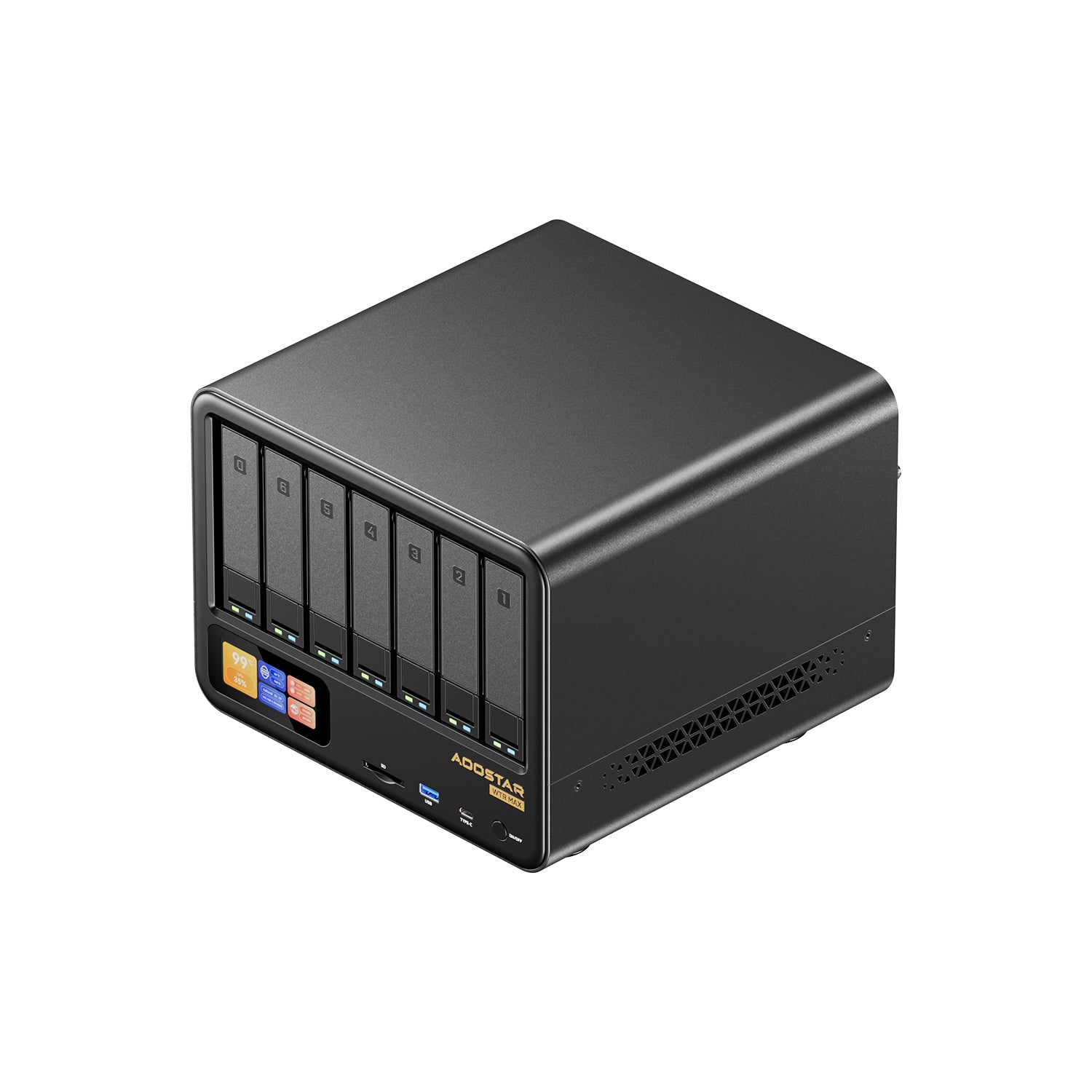
AOOSTAR product image showing the six-bay WTR Max storage layout.
→ Check the AOOSTAR WTR Max barebone
Five M.2 connectors do not mean five full-bandwidth links. AOOSTAR’s platform material describes mixed x1 and x2 allocations across the WTR Max slots. The exact N5 Max per-slot allocation is not documented clearly enough in the accepted source package to promise equal bandwidth across all five positions. Buyers planning an all-flash tier should verify the lane map for the exact firmware and board revision before purchasing drives.
Total platform cost worksheet
Do not compare the N5 Max’s configured price with the WTR Max barebone and stop there. Fill out every row:
| Cost category | N5 Max 64GB | AMD WTR Max |
|---|---|---|
| Enclosure and compute | Configured platform | Barebone |
| Memory | Included and fixed | Required, capacity chosen by buyer |
| OS storage | Small device included | Required |
| HDD pool | Required | Required |
| NVMe cache or model storage | Optional | Optional |
| 10GbE switch and cabling | Required to use full network | Required to use full network |
| UPS | Required for a serious NAS | Required for a serious NAS |
| Separate backup | Required | Required |
At the August 10 check, Amazon listed the N5 Max at $2,599 and the WTR Max barebone at $679. Treat those figures as a snapshot. The useful question is whether the N5 Max removes the need to buy and operate a separate local-AI machine.
Power and noise evidence is not symmetrical
VirtualizationHowto reported roughly 35 to 40 watts at Proxmox idle for its configured AMD WTR Max. NASCompares measured a different WTR Max configuration at about 18 watts with only the OS drive, about 24 watts with five SSDs, and roughly 52 to 53 watts at rest with six hard drives and five SSDs. The spread shows why drive count, operating system, network modules, and power settings must stay attached to every number.
We do not have an accepted independent N5 Max power or noise measurement for the exact 64GB retail configuration. Its 250W internal supply is a capacity specification, not a consumption figure. Do not assume it idles like the WTR Max or use MINISFORUM’s cooling claims as measured evidence.
Enter measurements from your final configuration into the power cost calculator. A ten-watt continuous difference adds 87.6 kilowatt-hours per year before local electricity pricing.
TrueNAS, Unraid, and local AI
For TrueNAS, the WTR Max has the more conventional storage-server shape: upgradeable ECC-capable memory, six SATA bays, and plentiful network interfaces. Our TrueNAS hardware guide explains the validation and recovery work that matters beyond specifications.
For Unraid, both systems can mix storage and applications, but the N5 Max has a clearer role when GPU-backed local AI shares the box. Fixed memory makes capacity planning important because it cannot be corrected later.
For a dedicated local-AI system, neither NAS layout is automatically best. A separate workstation can isolate model workloads from storage maintenance and failure domains. Consolidation saves space and idle power but increases the impact of downtime.
Split the workloads when uptime matters
A storage-focused WTR Max plus a separate AI workstation is the better architecture when model experiments can exhaust memory, saturate storage, or require restarts. It also lets the NAS remain available while the AI machine changes drivers or operating systems. The N5 Max earns consolidation only when one chassis, one power connection, and shared local storage are more valuable than that isolation.
Verdict
Buy the AOOSTAR WTR Max when the primary job is storage. Its extra SATA bay, upgradeable ECC-capable memory, OCuLink, and lower platform cost leave more budget for the parts that protect data.
Buy the N5 Max 64GB when you can identify local models that fit its memory, will run them often, and would otherwise buy another Ryzen AI Max+ 395 system. That is a narrow but legitimate use case.
Buy neither if you want turnkey support and polished storage software. A conventional NAS appliance may cost more per unit of compute but requires less integration work.
Frequently Asked Questions
Should I buy the N5 Max or AOOSTAR WTR Max?
Buy the N5 Max only if one system must handle five hard drives and serious local-AI work through its Ryzen AI Max+ 395 and fixed 64GB unified memory. Buy the AMD WTR Max for storage-first TrueNAS or Unraid builds that value six hard-drive bays, upgradeable ECC-capable memory, and a much lower barebone price.
Which NAS holds more drives?
Both expose eleven internal storage positions. The N5 Max combines five hard-drive bays with five M.2 positions plus its OS device. The AMD WTR Max combines six SATA bays with five M.2 positions.
Can the N5 Max memory be upgraded?
No. The exact Amazon-validated N5 Max in this comparison has 64GB LPDDR5X unified memory soldered to the platform. The AMD WTR Max uses two DDR5 SO-DIMM sockets and supports ECC-capable upgradeable memory.
Sources and verification
- MINISFORUM N5 Max product specifications
- NASCompares N5 Max platform coverage
- VirtualizationHowto AMD WTR Max review
- Mini PC Lab AOOSTAR WTR Max evidence review
The N5 Max and WTR Max identities, selected variants, stock, ratings, and prices were validated through Amazon product data on August 10, 2026. The comparison remains a draft until its final image, copy, link, and consistency gates pass.
Current buying links
- MINISFORUM N5 Max 64GB: Check current price
- AOOSTAR WTR Max barebone: Check current price