
This article contains affiliate links. If you purchase through our links, we may earn a commission at no extra cost to you. We only recommend products we’ve thoroughly researched and verified.
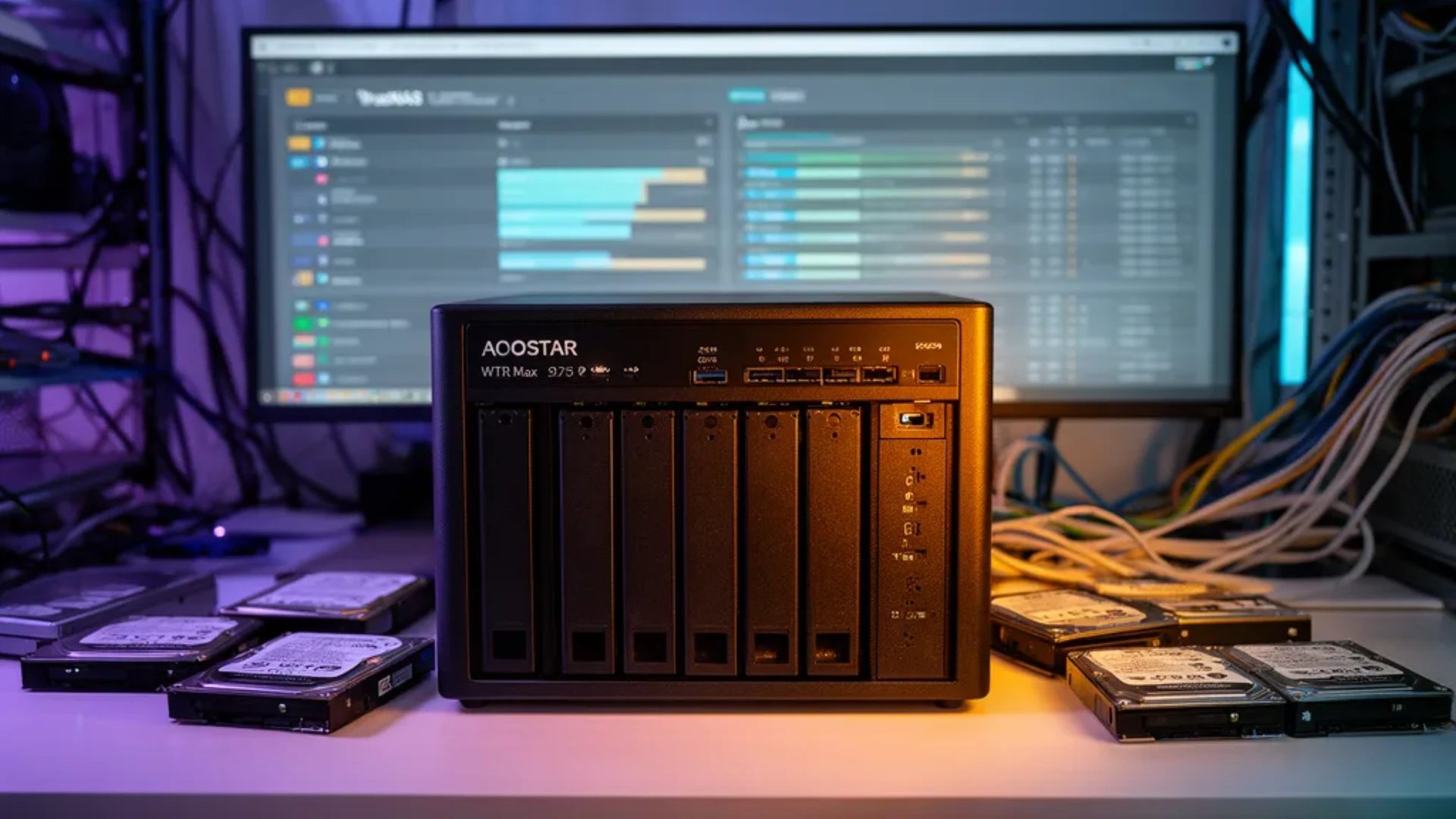
The AOOSTAR WTR Max is the mini PC that finally makes a serious DIY NAS look easy. It packs a Ryzen 7 PRO 8845HS, ECC-capable memory up to 128GB, eleven drive bays, and dual 10GbE into a desktop-sized box that costs less than the drives you will fill it with. For a homelab that outgrew a four-bay appliance, this is a lot of storage hardware for the money. It is not flawless, and the flaws are specific, so here is the honest review of what it does, what it costs to run, and where it trips owners up.
We verified the configuration and price through the Amazon product data on July 12, 2026, and we drew the power and performance measurements from NAS Compares’ review and consistent owner reports rather than a bench session of our own.
AOOSTAR WTR Max — Specs at a Glance
Before choosing drive sizes, work out what you actually keep after parity and what it costs per usable terabyte with the NAS capacity calculator. Parity drives cost full price and store none of your data, so the advertised cost per terabyte is never the real one.
| Spec | Detail |
|---|---|
| CPU | AMD Ryzen 7 PRO 8845HS, 8-core, 16-thread, Radeon 780M |
| Memory | ECC-capable DDR5, up to 128GB |
| Drive bays | 6 SATA bays plus 5 M.2 NVMe Gen4 slots |
| Networking | 2x 10GbE SFP+ Intel X710 plus 2x 2.5GbE |
| Expansion | OCuLink for external storage |
| Extras | Front LCD status panel, microSD slot |
| Power supply | 280W external |
| Idle power | ~18W OS only, ~52 to 53W with a full drive load at rest |
| Price | ~$699 barebones, no memory or storage |

Port layout from AOOSTAR’s own listing images. The rear panel is where the port count, the LAN speed, and the USB generations are actually settled.
Eleven Drive Bays Is the Whole Point
Most mini-NAS boxes give you four M.2 slots and call it a day. The WTR Max gives you six SATA bays for 3.5-inch hard drives up to 24TB each plus five M.2 NVMe slots, which is eleven drives in one small chassis. That mix is what makes it flexible. You can put a large parity or ZFS array on the spinning disks for bulk media and archives, then use the NVMe slots for fast app storage or a cache tier.
The drives sit in removable cartridges rather than fixed slots, which is a server touch that makes swapping a failed disk painless. Pair that capacity with ECC-capable memory and you have the foundation a data-integrity NAS actually wants, which is why the WTR Max lands so well for TrueNAS and Unraid. Our best mini PC for TrueNAS and best mini PC for NAS roundups put it against the rest of the field.
Compute: A NAS That Also Runs Everything Else
The Ryzen 7 PRO 8845HS is the reason the WTR Max is more than a storage shelf. With 8 cores, 16 threads, and Radeon 780M graphics, it has the muscle to be a NAS, a media server, and a virtualization host at once. Reviewers ran multiple hardware-accelerated Plex transcodes while the box served files, and launched six Windows and two Ubuntu virtual machines under Proxmox on a single unit without trouble. Our best mini PC for Plex guide explains what the 780M can do for transcoding.
The dual 10GbE SFP+ ports, built on Intel’s X710 controller, saturated cleanly in testing against a 10 gigabit workstation, which is what you want for large media libraries and NAS-to-NAS replication. Add ECC memory up to 128GB and this is a machine that can consolidate several boxes into one.
Power and Running Costs
For its capacity the WTR Max is reasonable on power, and the numbers scale with how many drives you load. In testing it idled around 18 watts with just the OS drive, rose to about 24 watts with five SSDs installed, and settled near 52 to 53 watts at rest with six hard drives and five SSDs populated. Under full load, with all drives active, Plex transcoding, and both 10GbE links saturated, it drew between 73 and 89 watts.
Those are healthy figures for eleven drives and a capable CPU, and the vapor-chamber cooler held temperatures steady during the load runs. For a machine that runs continuously, model the cost against your own rate with our power cost calculator. Owners who want it quieter swap the stock fans for Noctua NF-A8 units and report similar cooling with less noise.
The Real Caveats — Read Before You Buy
A fair review names the friction, and the WTR Max has a few specific points worth knowing:
- The NVMe slots run on limited PCIe lanes. With slots split across single-lane and dual-lane widths, NVMe-to-NVMe copies plateau around 550 megabytes per second rather than full SSD speed. For a NAS this is fine, since your network is usually the limit, but do not expect the M.2 array to run at benchmark speeds.
- There are two hardware versions. Some units ship the M.2 slots as PCIe 3.0 instead of 4.0, with only the onboard slot staying at 4.0. Check the listing details before ordering if lane speed matters to you.
- A 96GB memory kit may not post. Owners report that a two-stick 48GB configuration can fail to boot because of an AMD memory quirk on the 8845HS, so confirm a supported kit before buying memory.
- Enterprise drives need the right power cable. Some enterprise hard drives expect a SATA 3.3 power pinout, which differs from a standard desktop SATA power cable, so plan for the correct adapter.
- Expansion is OCuLink, not a PCIe slot. The WTR Max uses OCuLink for external storage rather than an internal PCIe slot, which suits some builds and frustrates buyers who wanted a standard card slot.
None of these are dealbreakers for a storage box, but each has caught an owner off guard. Buy through Amazon so you keep a return path if your unit arrives as the wrong hardware revision.
AOOSTAR WTR Max vs a Prebuilt NAS
The WTR Max’s real competition is a turnkey NAS from Synology or QNAP. Against those, it wins decisively on hardware for the money: more cores, ECC, dual 10GbE, and eleven bays for a price that established brands charge for a four-bay unit with a weaker CPU. It also runs any operating system you want, from TrueNAS to Unraid to Proxmox, which a locked appliance does not.
What you give up is polish and support. A Synology hands you a mature operating system, quieter defaults, and a warranty process you can trust. The WTR Max asks you to bring your own operating system, memory, and drives, and to accept a smaller company’s support. For a homelab builder that trade is usually worth it. For someone who wants storage to just work with a phone app, the appliance still makes sense. Our best mini PC for home server pillar frames that decision.
Who Should Buy the AOOSTAR WTR Max?
Buy it if you:
- Want a high-capacity DIY NAS with SATA bays and NVMe in one box
- Run TrueNAS or Unraid and value ECC memory support
- Need dual 10GbE for large media libraries or replication
- Want one machine to serve files, run Plex, and host virtual machines
Skip it if you:
- Want turnkey software and vendor support, where a Synology fits better
- Need full-speed NVMe throughput rather than NAS-level speeds
- Prefer a standard internal PCIe slot over OCuLink expansion
- Do not want to source your own memory and drives on top of the barebones price
Frequently Asked Questions
Is the AOOSTAR WTR Max a good NAS?
Yes, for a storage-heavy homelab. It combines a Ryzen 7 PRO 8845HS, ECC-capable memory up to 128GB, six SATA bays plus five M.2 NVMe slots, and dual 10GbE in a compact box. That feature set usually costs far more from an established brand. The main caveats are that it ships barebones with no memory or storage, and the many drive slots run on limited PCIe lanes.
Does the AOOSTAR WTR Max support ECC memory?
Yes. The WTR Max supports ECC memory, which is the reason it suits TrueNAS and ZFS where memory integrity protects the pool. That ECC support is unusual at this price and is a genuine reason to choose it over a consumer mini PC for a data-integrity build. Note that some owners report a 96GB two-stick configuration failing to post due to an AMD memory quirk.
How much power does the AOOSTAR WTR Max use?
In testing it idled around 18 watts with just the OS drive, rose to about 24 watts with five SSDs, settled near 52 to 53 watts with six hard drives and five SSDs at rest, and climbed to 73 to 89 watts under full load with all drives active, Plex transcoding, and dual 10GbE saturated. Those figures come from a reviewer’s measurements, not our own bench.
What is the catch with the AOOSTAR WTR Max?
Three things. The M.2 slots run at limited PCIe lane widths, so NVMe-to-NVMe copies plateau around 550 megabytes per second rather than full SSD speed. Some units ship the M.2 slots as PCIe 3.0 instead of 4.0, so check the listing. And it uses OCuLink for expansion instead of a standard PCIe slot, which not everyone wants.
AOOSTAR WTR Max or a Synology NAS?
The WTR Max gives you far more compute, ECC, dual 10GbE, and eleven drive slots for the money, and it runs any operating system you like such as TrueNAS or Unraid. A Synology gives you a polished operating system, quieter default behavior, and vendor support. Choose the AOOSTAR for flexibility and hardware value, and a Synology when you want turnkey software and a warranty you trust.
Can the AOOSTAR WTR Max run Plex and virtual machines?
Yes. The Ryzen 7 PRO 8845HS with Radeon 780M handles multiple hardware-accelerated Plex transcodes, and reviewers ran several Windows and Ubuntu virtual machines under Proxmox at the same time. With ECC memory up to 128GB it has the headroom for a combined NAS, media server, and virtualization box in one chassis.
How We Research These Picks
We verified the AOOSTAR WTR Max configuration, price, and availability against the Amazon product data on July 12, 2026, and we based the power measurements, throughput figures, and thermal behavior on NAS Compares’ review and consistent owner reports rather than a bench session of our own. We flag the PCIe-lane limits, the two hardware revisions, the 96GB memory quirk, and the SATA power detail because each has caught buyers out. Every figure here carries its source, and we make no hands-on testing claim we did not perform.
Amazon Product Links
- AOOSTAR WTR Max — the 11-bay Ryzen NAS: Check Current Price