
This article contains affiliate links. If you purchase through our links, we may earn a commission at no extra cost to you. We only recommend products we’ve thoroughly researched and verified.
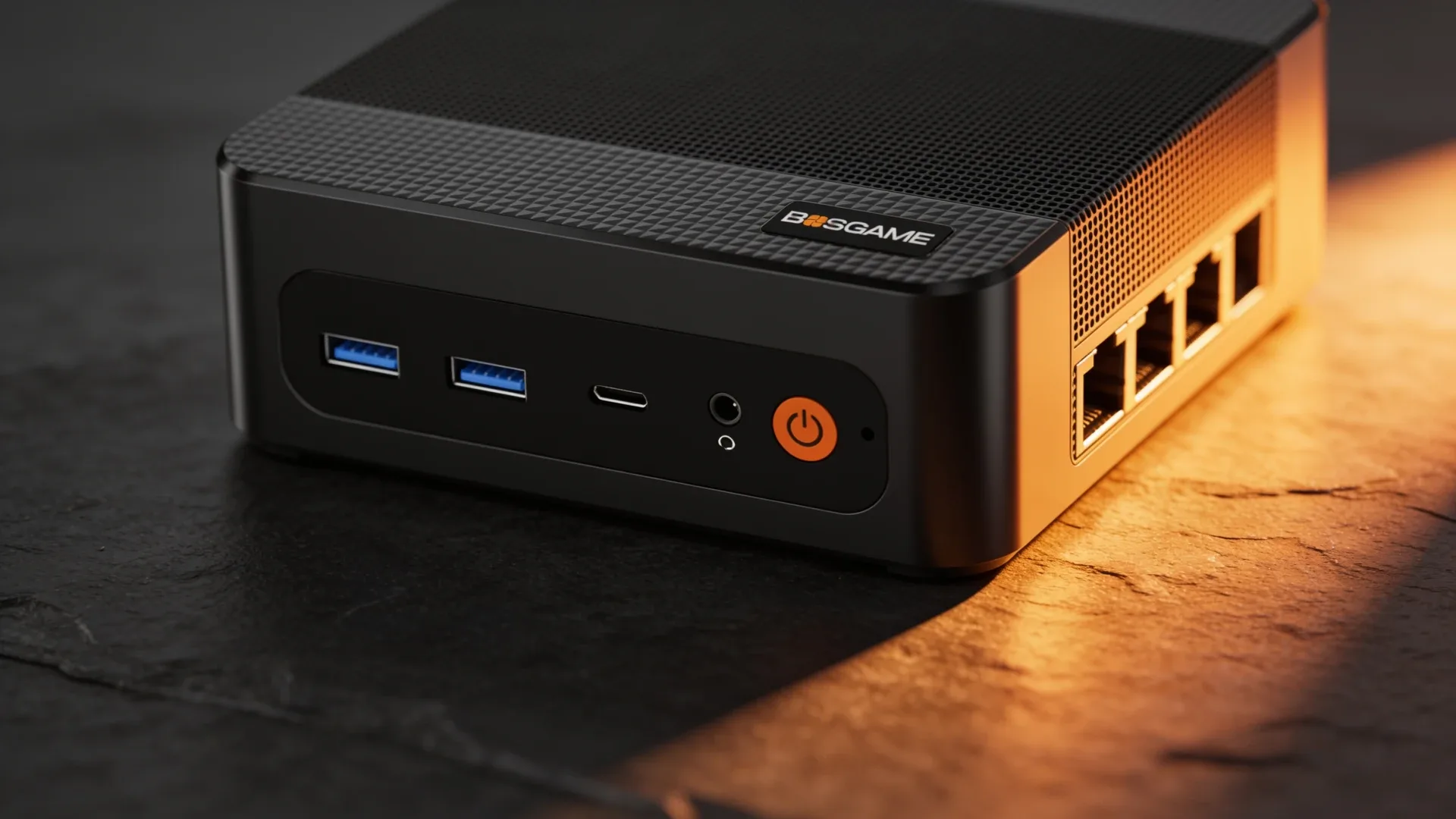
The BOSGAME P6 is a compact Ryzen 9 6900HX machine that reads much stronger on a product page than it does on a spec sheet you have checked yourself. Eight cores, sixteen threads, 24GB of LPDDR5X, a 1TB PCIe 4.0 drive, dual LAN, Wi-Fi 6E, and triple 4K output for somewhere around $600 sounds like a homelab bargain. Two of those bullets do not mean what most buyers assume, and one of them decides whether this machine belongs in a rack cupboard or on a desk.
We verified this configuration against the live Amazon listing, BOSGAME’s own store page, and the manufacturer’s spec graphics on the listing itself on July 22, 2026. Those three sources contradict each other in three places, and this review says which one wins instead of quoting the flattering number.
→ Check Current Price on Amazon

Quick Verdict
The P6 is a good desk computer and a poor homelab node. As a triple-monitor office and light-gaming box it is well judged: eight fast cores, dual-fan cooling that BOSGAME rates under 36 dB, Wi-Fi 6E, and a port layout that drives three 4K panels without an adapter. As infrastructure it stumbles on two hard limits — the memory is soldered at 24GB forever, and the two Ethernet ports are gigabit rather than 2.5GbE.
The price is the other half of the decision. At the roughly $640 list price we saw on July 22, 2026 you are paying Zen 4 money for a 2022 Zen 3+ platform, and the GMKtec K12 with upgradeable DDR5 and a faster Radeon 780M is right there. On a deal near the $520 that TechRadar covered, the calculation flips and the P6 becomes a sensible buy.
If you are still comparing the whole field, start with our best mini PC for home server guide.
The Machine on Paper
Review Pick
BOSGAME P6
| Spec | Detail |
|---|---|
| CPU | AMD Ryzen 9 6900HX, 8 cores, 16 threads, up to 4.9GHz, Zen 3+ on 6nm |
| GPU | AMD Radeon 680M, RDNA 2, up to 2400MHz |
| CPU TDP | 45W |
| Memory | 24GB LPDDR5X at 4800MHz, soldered on board, no upgrade path |
| Storage | 1TB M.2 2280 NVMe PCIe 4.0 x4, plus a second M.2 2280 PCIe 4.0 x4 slot |
| Storage ceiling | 4TB in the second slot per BOSGAME’s own listing graphic |
| Ethernet | Dual gigabit RJ45 on a Realtek RTL8111H controller — not 2.5GbE |
| Wireless | Intel AX210 Wi-Fi 6E, Bluetooth 5.3 after the Intel driver, 5.2 out of the box |
| Display | HDMI 2.0, DisplayPort, and USB-C, all 4K at 60Hz, three at once |
| USB | 3× USB-A 3.2 Gen 2 at 10Gbps, 1× USB-A 2.0, 1× USB-C with 10Gbps data, video, and PD 3.0 |
| USB-C power | 100W PD input, 15W output |
| Cooling | Dual-fan, rated under 36 dB by BOSGAME |
| Dimensions | 129 × 123 × 44 mm |
| Extras | Wake-on-LAN, auto power-on after power is restored, Kensington lock slot |
| OS | Windows 11 Pro preinstalled, Ubuntu and Linux supported |
| Typical price | ~$520–$640 |
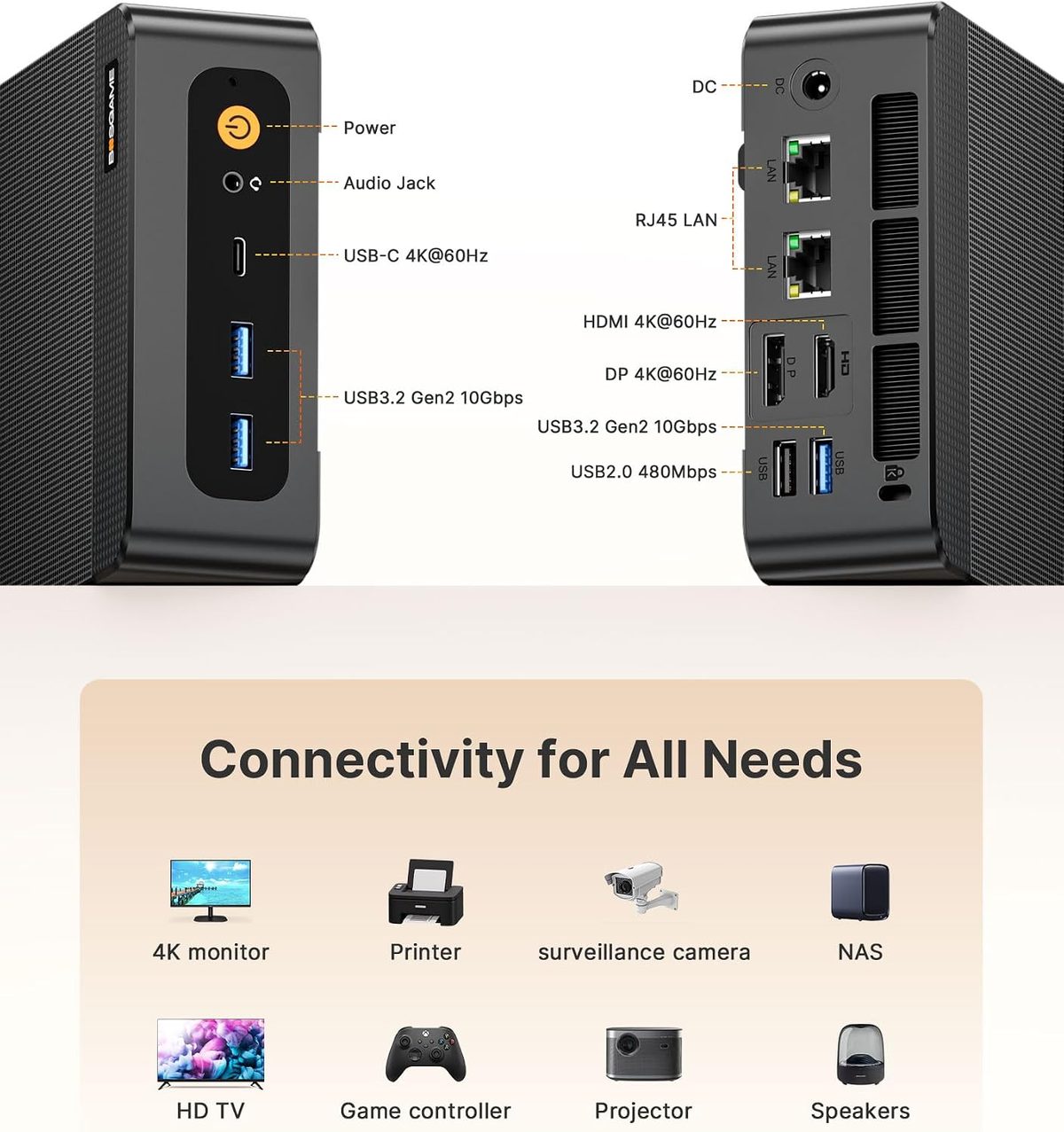
Port layout from BOSGAME’s own listing diagram. Note the rear stack: two RJ45 jacks, and one of the two rear USB-A ports is USB 2.0 rather than 10Gbps.
→ Check Current Price on Amazon
Where the Sources Disagree, and Which One Is Right
This is the part the listing will not tell you about itself. Reading the Amazon listing, BOSGAME’s own store page, and the manufacturer’s product graphics on the listing itself on July 22, 2026 turns up three contradictions. Two of them are settled by BOSGAME’s own images.
| Claim | Amazon text says | BOSGAME store page says | BOSGAME’s listing graphics say | Verdict |
|---|---|---|---|---|
| Memory speed | 4800MT/s | LPDDR5X 6400MHz | “24G LPDDR5X 4800MHz On Board” | 4800MHz. Two sources to one |
| Storage expansion | Up to 8TB | Up to 4TB | “Expandable up to 4TB” | 4TB. Two sources to one |
| Warranty | 1 year machine, 3 years parts | 1 year plus support | not shown | Unresolved. Rely on the 1-year term |
TechRadar, covering a discount on this machine, described it as a Ryzen 9 6900HX with 24GB LPDDR5X, a 1TB PCIe 4.0 SSD, and dual Gigabit LAN. That is a source with nothing to sell here agreeing on the two specs that decide the purchase. So the promoted 6400MHz figure on BOSGAME’s own store page is the outlier, and the machine you receive is a 4800MHz part. Memory bandwidth is the main brake on any integrated GPU, so that gap is not nothing for gaming, and since the memory is soldered it is not something you can fix later either. Plan on 4800MHz.
The pattern matters more than any single line. This vendor’s marketing copy is not carefully maintained, so verify anything load-bearing before the return window closes. Bluetooth is a smaller example of the same thing: it ships as 5.2 and only becomes the advertised 5.3 after you install Intel’s current driver, which the listing does at least disclose.
A fourth confusion is worth clearing up because it is everywhere in search results. Older BOSGAME P6 listings and several video reviews describe a 32GB model. The listing this review covers is the 24GB configuration, and the memory is soldered either way, so confirm which one is in your cart.
What a Ryzen 9 6900HX Buys You in 2026
The 6900HX is an eight-core, sixteen-thread Zen 3+ chip on a 6nm process, boosting to 4.9GHz, with Radeon 680M graphics. When it launched in 2022 it was the fastest thing you could get in a machine this size. It is still quick. What has changed underneath it is everything it competes against.
For CPU-bound desk work — a browser with forty tabs, a couple of containers, a Node or Rust build, 1080p editing in DaVinci Resolve — you will not feel a meaningful gap between this and a current Zen 4 mini PC. Eight strong cores remain eight strong cores.
The gap shows up in graphics and efficiency. The Radeon 680M is RDNA 2 with 12 compute units; the Radeon 780M in Zen 4 boxes such as the K12 and the BOSGAME P3 Plus is RDNA 3 with the same unit count but higher clocks and a newer feature set. For esports titles at 1080p both are adequate. For anything heavier, or for AV1 encode, the newer part is the one to want.
Which leads to the honest framing: the 6900HX is not a bad chip, it is a chip that should now be priced like a 2022 chip. Judge every P6 listing against that standard.
Power Draw and What It Costs to Run
BOSGAME publishes no power figures, and we have no bench data for this machine, so here are attributed measurements from the same silicon in other chassis:
- ServeTheHome, reviewing the Minisforum UM690 on the same Ryzen 9 6900HX, recorded 8 to 10 watts at idle and peaks in the 65 to 75 watt range, with a 120W brick.
- Igor’s Lab, testing the Acemagic AM08 Pro on the same chip, measured a 71.7 watt maximum for the whole system, with the CPU peaking at 77.4°C.
Those two independent measurements agree closely enough to plan around. At 12 cents per kWh:
| Usage pattern | Assumed draw | Annual electricity |
|---|---|---|
| Idle around the clock | 10W | ~88 kWh, about $10.50 |
| Light always-on server, 15W average | 15W | ~131 kWh, about $15.80 |
| Eight hours of desk work a day | 45W | ~131 kWh, about $15.80 |
| Sustained heavy load around the clock | 70W | ~613 kWh, about $73.60 |
Run your own electricity rate through our power cost calculator before you compare this to a larger tower. The practical takeaway is that idle draw, not peak draw, decides the bill for an always-on box, and this platform idles well.
Where the P6 Actually Fits
A triple-monitor desk machine. This is the strongest case. HDMI 2.0, DisplayPort, and a full-function USB-C port each drive a 4K panel at 60Hz, so a three-screen desk needs no dock and no adapter chain. BOSGAME’s port graphic also rates that USB-C port for 100W of power delivery input and 15W output, so the machine can take power over USB-C instead of the barrel jack. Add Wake-on-LAN and automatic power-on after an outage, and it behaves well as a machine you leave running and reach remotely.
Light virtualization. With 24GB of memory and sixteen threads, two or three small virtual machines or a healthy stack of containers is comfortable. Reserve 4GB for the host and you have roughly 20GB to divide. Our VM capacity estimator will size that against your actual workload. What you cannot do is grow into it later, because the memory ceiling is fixed.
A soft router, with two caveats. Two separate Ethernet ports do make OPNsense, pfSense, or OpenWrt viable, and BOSGAME markets the machine for exactly that. Gigabit is enough for the large majority of home connections.
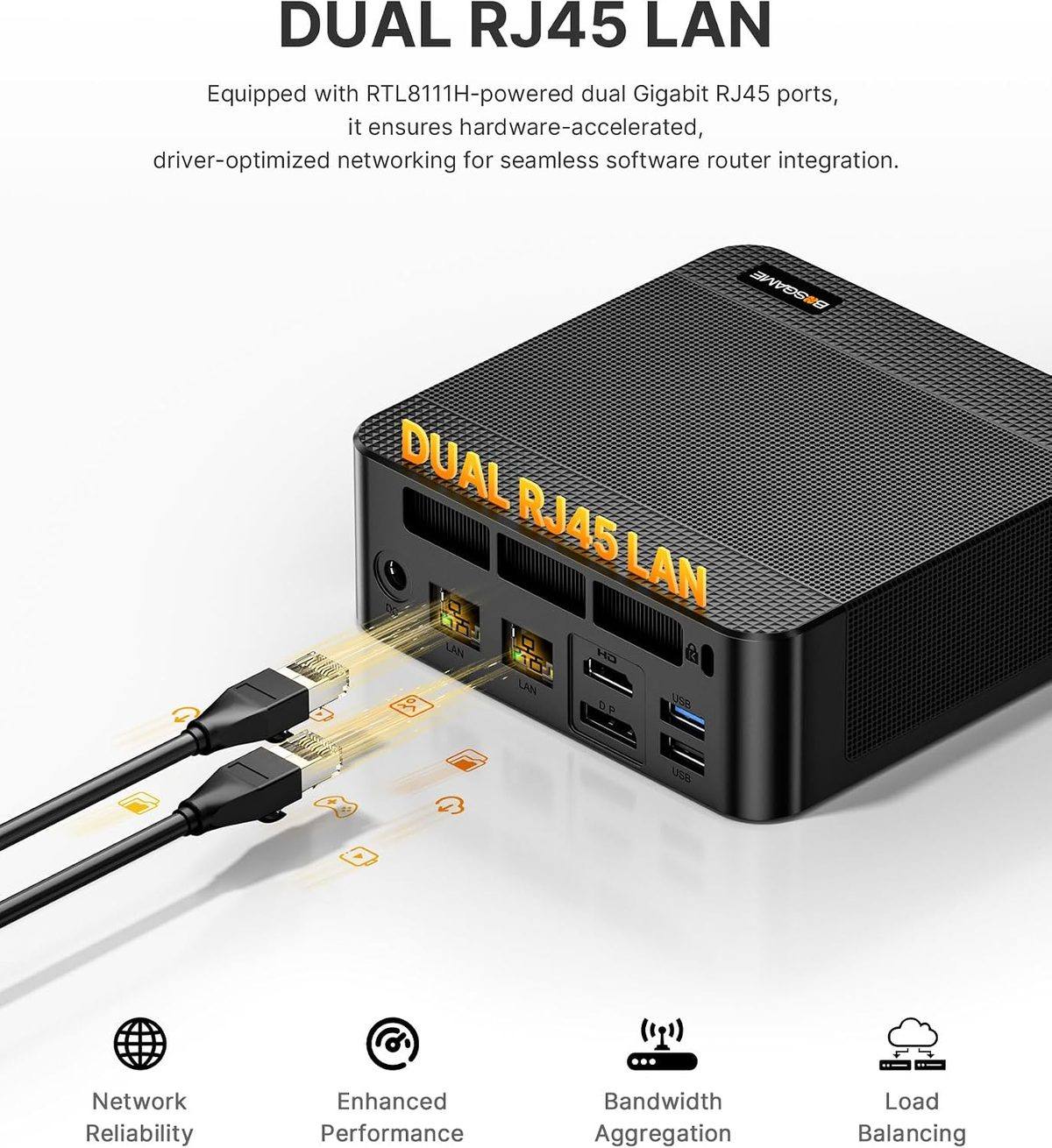
The first caveat is speed: if your internet is faster than a gigabit, or you want the router to move files between VLANs at speed, this is the wrong box. The second is the controller. BOSGAME’s own graphic names it a Realtek RTL8111H, and that matters more on a firewall than anywhere else. Realtek gigabit parts are well handled on Linux through the r8169 driver, so OpenWrt and Linux-based routing are fine. FreeBSD-based firewalls, which is what pfSense and OPNsense are, have historically been more dependable on Intel i225 and i226 silicon — which is why the picks in our best mini PC for firewall guide lean Intel. Treat the P6 as a workable OPNsense box rather than a recommended one.
Media playback and modest transcoding. The Radeon 680M sits on AMD’s VCN 3.1 media block. According to the X.Org RadeonFeature table, that generation covers H.264 and HEVC encode and decode plus AV1 decode, with AV1 encode arriving only in VCN 4.0. That is enough for Plex or Jellyfin serving a few clients. The gigabit link is the tighter constraint, not the chip.
→ Check Current Price on Amazon
Where It Does Not Fit
A NAS or storage node. One free M.2 slot capped at 4TB, no SATA bays, and gigabit networking cap this hard. A single gigabit link tops out near 110 MB/s in practice, which is slower than the drives on both ends. Our best mini PC for NAS picks have the bays and the network ports this lacks.
A machine you expect to grow. Soldered memory is the defining limitation. If your plan involves 64GB someday, buy a machine with SO-DIMM slots now and save yourself the second purchase.
Local AI work. 24GB of shared memory on an RDNA 2 integrated GPU will run small quantized models slowly. If that is the goal, the machines in our best AI mini PC guide exist for it.
Serious gaming. The 680M handles esports at 1080p and not much beyond. There is no OCuLink port here, so an external graphics card is not the escape hatch it is on the K12 or the EVO-X1. Our best mini PC for gaming guide covers the machines that do this properly.
How It Compares at the Same Money
All four alternatives were price-checked on July 22, 2026. Prices move constantly, so treat these as a snapshot that tells you where the P6 sits, not as today’s numbers.
| Machine | CPU and graphics | Memory | Networking | Price on July 22, 2026 |
|---|---|---|---|---|
| BOSGAME P6 | Ryzen 9 6900HX, Radeon 680M | 24GB LPDDR5X soldered | Dual 1GbE | ~$640 |
| GMKtec K12 | Ryzen 7 H255, Radeon 780M | 32GB DDR5, upgradeable | Dual 2.5GbE, OCuLink | ~$690 |
| BOSGAME P3 Plus | Ryzen 7 7840HS, Radeon 780M | 16GB DDR5, upgradeable | Dual gigabit | ~$700 |
| Minisforum UM880 Plus | Ryzen 7 8845HS, Radeon 780M | 32GB DDR5, upgradeable | 2.5GbE, OCuLink | ~$789 |
| Beelink SER9 | Ryzen 7 H255, Radeon 780M | 24GB LPDDR5X soldered | 2.5GbE | ~$799 |
Read the table honestly and it says the P6 is the cheapest of the group and the only one with neither upgradeable memory nor 2.5GbE. Fifty dollars more buys the GMKtec K12 and its newer platform, socketed memory, faster networking, and an external-GPU port. That is the comparison that should decide this purchase, and it is why the P6 needs a discount to make sense. Our BOSGAME mini PC guide covers the rest of the lineup, and the comparison tool will put any two of these side by side.
Who Should Buy the BOSGAME P6?
Buy it if you:
- Want a quiet three-monitor desk computer with eight strong cores and no dock
- Find it discounted meaningfully below the Zen 4 machines listed above
- Are happy with 24GB of memory permanently
- Need a soft router or lab box on a connection at or below gigabit
Skip it if you:
- Want 2.5GbE, a NAS role, or fast file movement between machines
- Might ever want more than 24GB of memory
- Are paying full list price, where the K12 is the better machine for slightly more
- Want serious gaming, local AI, or an OCuLink upgrade path
→ Check the current BOSGAME P6 price on Amazon
Frequently Asked Questions
Is the Ryzen 9 6900HX still worth buying in 2026?
For a desktop, yes. Eight Zen 3+ cores and sixteen threads still handle office work, code compiles, 1080p video editing, and two or three light virtual machines without complaint. What has changed is the price you should pay. The 6900HX launched in 2022, and Zen 4 chips such as the Ryzen 7 8845HS and H255 sit at the same money with a faster Radeon 780M. Buy the P6 on a discount, not at full list.
Does the BOSGAME P6 have 2.5GbE networking?
No. The Amazon listing text, BOSGAME’s store page, and BOSGAME’s own listing graphic all describe dual gigabit RJ45 ports, and the graphic names the controller as a Realtek RTL8111H. The phrase Dual LAN in the title is easy to misread as 2.5GbE. Two gigabit ports are fine for a soft router or for network isolation, but they cap transfers near 110 MB/s per link and rule the P6 out if you wanted a 2.5GbE homelab node.
Can you upgrade the RAM in the BOSGAME P6?
No. The 24GB of LPDDR5X is soldered to the board, which is what LPDDR memory means. There are no SO-DIMM slots to open up. Twenty-four gigabytes is a comfortable amount for a desktop and enough for a couple of virtual machines, but it is a hard ceiling for the life of the machine. Rivals such as the GMKtec K12 and Minisforum UM880 Plus use socketed DDR5 instead.
How much power does the BOSGAME P6 use?
BOSGAME publishes no figure. ServeTheHome measured 8 to 10 watts at idle and 65 to 75 watt peaks on the Minisforum UM690, a different chassis built on the same Ryzen 9 6900HX. At 10 watts running around the clock and 12 cents per kWh, that is roughly 88 kWh and about $10.50 a year. Treat those numbers as platform guidance rather than a measurement of this exact box.
Is the BOSGAME P6 good for Plex or Jellyfin?
For decoding and light transcoding, yes. The Radeon 680M sits on AMD’s VCN 3.1 media block, which handles H.264 and HEVC encode and decode plus AV1 decode according to the X.Org RadeonFeature table. AV1 encode needs the newer VCN 4.0 generation. The gigabit networking matters more here than the silicon does, since a busy 4K library will saturate a single gigabit link before the iGPU runs out of headroom.
BOSGAME P6 or GMKtec K12?
The K12 is the better machine for most buyers at a similar price. It pairs a Zen 4 Ryzen 7 H255 with the faster Radeon 780M, 32GB of upgradeable DDR5, and an OCuLink port for an external graphics card. The P6 answers back with a lower typical street price and a cleaner triple-display setup. If the P6 is discounted well below the K12 and you never plan to upgrade memory, it makes sense.
Why do BOSGAME P6 listings show different memory speeds?
Because the sources disagree, and the higher number is the wrong one. The Amazon listing title says 4800MT/s and BOSGAME’s own spec graphic on that listing says 24G LPDDR5X 4800MHz on board, while BOSGAME’s separate store page still advertises 6400MHz. Two sources to one puts the shipping configuration at 4800MHz. Older 32GB listings and video reviews add further confusion, so check which configuration is in your cart.
How We Research These Picks
On July 22, 2026 we read the live Amazon listing, BOSGAME’s own store page, and the manufacturer’s spec and port graphics on that listing, and compared all three against each other. That comparison is what produced the memory-speed, storage-ceiling, and warranty conflicts in this review, and it is where the full port breakdown and the Realtek RTL8111H network controller came from. The port and rear-panel images here are BOSGAME’s own diagrams, credited as such rather than presented as our photography. TechRadar’s coverage of the discounted P6 served as a non-vendor check on the two specs that decide this purchase, the 24GB memory and the gigabit networking, and it agrees.
Power and thermal figures are not ours and are not from this exact machine. They come from ServeTheHome’s Minisforum UM690 review and Igor’s Lab’s Acemagic AM08 Pro review, both built on the same Ryzen 9 6900HX in a different chassis, and they are labelled that way everywhere they appear. Media-engine capability comes from the X.Org RadeonFeature table for AMD’s VCN 3.1 generation. Every competitor price in the comparison table was checked on the same day as the P6’s.
Two gaps are worth stating plainly. Owner reviews for this machine could not be retrieved on the day we checked, so nothing here is drawn from what buyers report. And we have not run this machine ourselves — there is no bench session behind this review, and we make no measurement claim about the box in front of you.
Amazon Product Links
- BOSGAME P6 — Ryzen 9 6900HX, 24GB LPDDR5X, 1TB: Check Current Price
- GMKtec K12 — the Zen 4 alternative with upgradeable memory: Check Current Price